

The Complete History of Simpson Shaving Brushes: From London in 1919 to the Isle of Man
Few names in traditional wet shaving carry the same authority as Simpson.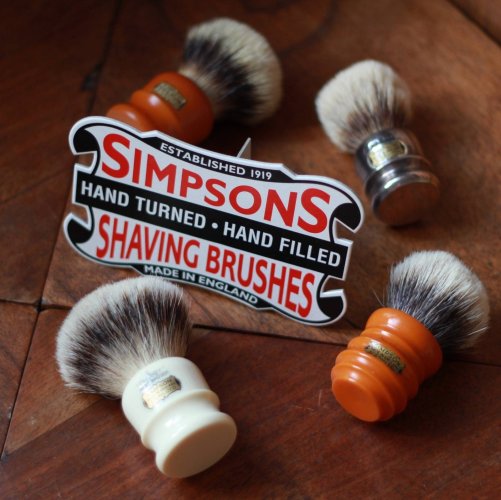
Many manufacturers produce excellent shaving brushes, but Simpson occupies a special position. Its handles are instantly recognisable, its densely packed knots have influenced generations of brush makers, and model names such as Chubby, Duke, Tulip, Persian Jar, Polo and Wee Scot have become part of the vocabulary of traditional shaving.
The story of Simpson is not simply the history of one British manufacturer. It is also the story of how the shaving brush evolved during the twentieth and early twenty-first centuries: from ivory handles and water-powered machinery to modern resins, limited editions and advanced synthetic fibres.
It is a story that begins in London in 1919.
Alexander E. Simpson and the Birth of the Company
Alexander E. Simpson was a Scotsman with family connections to brush making. In 1919, he began producing shaving brushes and other male-grooming accessories in London.The company’s official history records its first listed address as 53 High Street, Clapham, London SW4. By 1929, Simpson had established a sufficient reputation to exhibit at the prestigious British Industries Fair, where British manufacturers presented their finest products to domestic and international buyers.
The timing was favourable. Safety razors were making personal shaving more accessible to men from a much wider range of social and economic backgrounds. Gary Young, Alexander Simpson’s great-nephew, later explained that the growing popularity of the double-edge razor encouraged the company to offer a broader selection of brush designs, prices and sizes.
Simpson was therefore not created solely as a luxury manufacturer. Although the company would become associated with some of the finest brushes available, its catalogue historically included models for different budgets, tastes and shaving habits.
The Early Simpson Identity
Several characteristics that enthusiasts now associate with Simpson were established during the company’s early decades.The first was knot density. Simpson brushes became known for holding considerably more hair than many competing brushes. This created a distinctive combination of backbone, firmness and lather capacity.
The second was the use of strong, substantial handle designs. Rather than relying exclusively on slender or highly decorative forms, Simpson produced handles such as the Chubby and Duke that felt solid and purposeful in the hand.
Gary Young described dense knots and strong handles as defining Simpson characteristics. He also explained that many early designs were created experimentally at the lathe. New shapes sometimes emerged simply from turning a piece of material and observing what form developed.
This helps explain why the Simpson catalogue contains so many distinctive silhouettes. The handles were not created as variations of a single standard pattern. Each family developed its own identity.
From Ivory to Catalin and Modern Resins
Early Simpson craftsmen frequently worked with ivory. From a turner’s perspective, ivory behaved somewhat like a very fine hardwood and allowed complex forms to be created on a lathe.Ivory, however, could crack and split as it aged. Its increasing scarcity and the ethical and legal restrictions surrounding its use made a transition to alternative materials unavoidable.
One important replacement was Catalin, a colourful cast phenolic resin popular during the first half of the twentieth century. Catalin could be turned and polished effectively, allowing Simpson to retain the flowing lines and detailed shapes of its earlier handles.
Over time, modern synthetic rods and resins replaced both ivory and Catalin. The familiar Simpson faux-ivory finish maintained the appearance of the traditional brushes without using animal-derived handle material. Modern production has also expanded into tortoiseshell effects, marbled patterns, bright colours and numerous limited-edition materials.
The Destruction of the London Factory
The defining event in Simpson’s early history occurred during the Second World War.In 1941, the company’s London factory was destroyed during the Blitz. Rather than abandon production, Alexander Simpson relocated the business to Nimmer Mills near Chard in Somerset.
This move began the era that many collectors now refer to simply as “Somerset Simpson.”
Nimmer Mills gave the company an entirely different character. Instead of operating in industrial London, Simpson was now working from a traditional mill in the English countryside. Water power was reportedly used to operate machinery including the lathes.
Although the relocation was forced by war, it ultimately strengthened the image of Simpson as a traditional British craft manufacturer. The setting, the machinery and the skills passed between generations became inseparable from the company’s identity.
Alexander Simpson apparently considered returning the business closer to London, where much of its customer base remained, but the company ultimately stayed in Somerset.
The Nimmer Mill and Somerset Years
Production at Nimmer Mills was divided among skilled workers.Some employees turned handles, others formed knots, while additional workers set the knots, applied markings and prepared the brushes for sale. Only a relatively small number of people knew every stage required to make a complete brush.
The knowledge was traditionally passed from experienced workers to apprentices and family members. This made continuity extremely important. The loss or retirement of a skilled employee could mean the loss of knowledge that had taken years to acquire.
Simpson shared production facilities at Nimmer Mills with Coates, another respected name in British shaving. The relationship between the two companies became sufficiently close that their histories during the Somerset period are often discussed together.
Simpson also manufactured brushes for major department stores and grooming establishments. Standard Simpson designs were sometimes rebranded as house brushes for retailers including Harrods, Macy’s and Cable Car Clothiers, while slightly modified or bespoke designs were made for specialist perfumers and chemists such as Floris and E.R. Cooper.
Consequently, some vintage brushes with unfamiliar names or decals may still have a direct connection to Simpson manufacture.
The Origins of Famous Simpson Brush Names
Part of the appeal of Simpson is that many of its model names have stories behind them.The Chubby
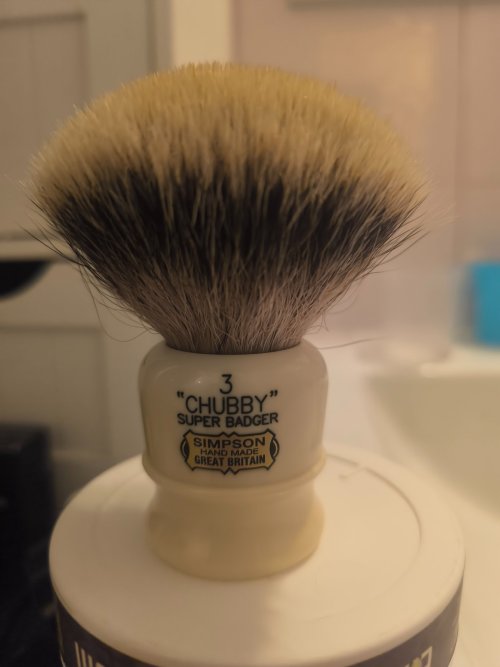
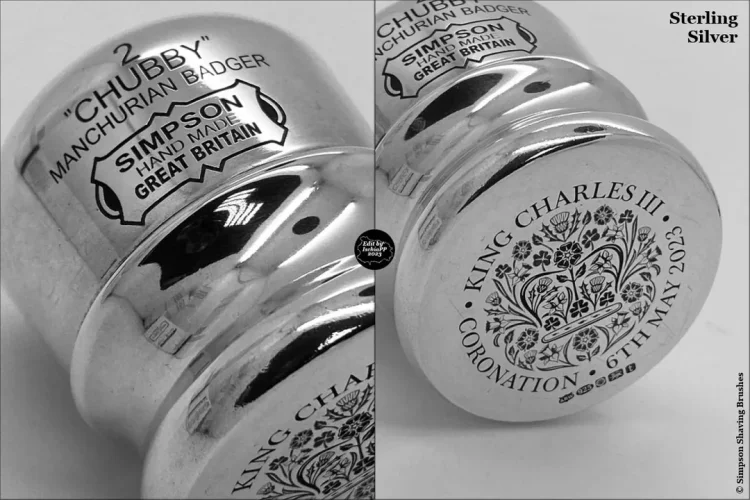
The name is refreshingly straightforward. Its short, thick handle was considered “chubby,” and the description became the model name.The Chubby developed into perhaps the most recognisable Simpson brush of all. It combines a compact handle with an exceptionally dense knot and is traditionally produced in three sizes: Chubby 1, Chubby 2 and Chubby 3.
The Chubby 2 occupies a particularly important place in the company’s history. Gary Young identified the Chubby 2 in Best Badger as his personal favourite and stated that Alexander Simpson and later generations of the family used that configuration regularly.
Modern Simpson literature continues to present the Chubby as the company’s flagship face-lathering brush, emphasising its knot density and hand-tied construction.
The Duke
The Duke is one of Simpson’s most versatile and enduring handle designs.According to family history, “Duke” was Alexander Simpson’s nickname. The brush therefore carries a direct personal connection to the company’s founder.
Compared with the Chubby, the Duke generally offers a slightly more conventional handle and knot relationship. It has become a popular entry point into Simpson badger brushes without feeling like a lesser or simplified model.
The Wee Scot
The Wee Scot is one of the smallest fully functional shaving brushes in regular production.Despite its tiny dimensions, it can create sufficient lather for a complete shave. Its name reflects both its size and Alexander Simpson’s Scottish origins.
Family accounts suggest that the Wee Scot was especially close to the founder’s heart, even though his everyday brush was reportedly a Chubby 2 in Best Badger.
The Persian Jar
The Persian Jar takes its name from the elegant curves of its handle. Its flowing profile was intended to resemble the lines of ancient ceramic jars and decorative chinaware.Unlike the muscular Chubby, the Persian Jar presents a taller, more graceful silhouette. It remains one of Simpson’s best-selling classical designs and is still produced in three principal sizes.
The Keyhole
The Keyhole, normally identified by the letters KH, was named for the distinctive outline of its handle. Viewed from the front, the narrow waist and broader upper and lower sections resemble a traditional keyhole.The design demonstrates how Simpson could take a simple visual idea and transform it into a practical, recognisable shaving brush.
The KR7
Some Simpson names had much more personal origins. The vintage KR7 was named after No. 7 Kents Row, the address of a member of the Nimmer Mill staff.This small detail illustrates how employees and family life influenced the company’s catalogue. Not every brush was named through a formal marketing process; some names emerged naturally from the people surrounding the business.
The Major
The Major is one of Simpson’s most ingenious travel brushes.It was designed for Major Victor Beeching, described by Simpson as an adventurous Himalayan explorer. The knot and upper handle screw into an open-ended protective tube, allowing the brush to be transported while still receiving some ventilation.
The model remains in production and is an example of a genuinely practical design surviving for generations rather than being retained merely for nostalgia.
Other Important Simpson Families
Beyond these historically documented names, Simpson developed an unusually large catalogue.The Tulip combined a narrow waist with a flared base and became one of the brand’s most elegant forms. The Polo offered a tall, substantial handle suited to shavers who prefer more reach. The Colonel and Commodore provided traditional styling at more approachable price points, while models such as the Emperor, Eagle, Milk Churn, Classic, Berkeley, Beaufort and M7 broadened the range further.
Some designs disappeared, returned in limited editions or evolved into slightly different specifications. This has made vintage catalogues particularly interesting to collectors.
Two brushes bearing the same historical model name may vary in knot dimensions, hair characteristics or handle material depending upon when they were manufactured.
Badger Hair and the Traditional Simpson Knot
Natural badger hair became central to Simpson’s reputation.Historically, the company sourced hair from the Balkans before availability led to greater reliance on Chinese supply. Simpson also produced substantial quantities of boar brushes, even though modern enthusiasts often associate the brand primarily with badger.
Simpson’s principal badger grades have included Pure, Best, Super or Silvertip, Two-Band Silvertip and Manchurian.
Pure Badger traditionally provides the greatest degree of scrub and texture. Best Badger uses finer, more pliable hair and has long represented the characteristic everyday Simpson experience. Super or Silvertip generally offers lighter, naturally pale tips and a softer sensation. Manchurian is normally reserved for premium or limited-edition brushes and is selected for its stronger shafts, pronounced backbone and soft tips.
These descriptions should not be treated as universal industry standards. Hair grading terminology varies between manufacturers, and natural hair can differ between batches. Loft, density, knot shape and handle geometry can affect a brush at least as much as the grade printed on its decal.
This natural variation is part of the attraction of handmade badger brushes, but it also means that two examples of the same model may not feel completely identical.
Receivership and a Change of Ownership
By the end of the twentieth century, Simpson and Coates were facing commercial difficulties.In 1990, the two companies entered a receivership arrangement and were purchased by David Carter and Francis Woodhouse. The original Simpson and Young family was therefore no longer in control of the business, although production continued in Somerset.
This period preserved many of the famous designs and manufacturing traditions, but maintaining an ageing workforce became increasingly difficult. Traditional brush making depends heavily upon manual skill, and experienced craftspeople cannot be replaced immediately by machinery or newly recruited staff.
In 2007, David Carter decided to sell the Simpson business. He wanted the brand to remain within the British Isles and sought a buyer capable of continuing the traditional methods used to construct the brushes.
The 2008 Vulfix Acquisition
In May 2008, the Simpson name was acquired by Progress Shaving Brush (Vulfix) Limited.Vulfix was already a respected British brush manufacturer based on the Isle of Man. The relationship between David Carter and Vulfix managing director Philip Watterson helped make the transfer possible.
The machinery, designs and Simpson brand were relocated from Somerset to the Isle of Man. According to the company, Vulfix was selected partly because it was one of the last manufacturers in the British Isles still capable of forming its brush knots entirely by hand.
The objective was not to absorb Simpson and eliminate its identity. It was to preserve the historic designs while placing the company within an organisation capable of training new craftspeople and maintaining production.
Today, Simpson and Vulfix are manufactured under the same ownership, but the brands retain distinct catalogues and identities.
Somerset Simpson and Isle of Man Simpson
Among collectors, brushes are commonly divided into two broad periods.A Somerset Simpson is generally a brush manufactured before the 2008 relocation. An Isle of Man Simpson is one produced by Progress Shaving Brush after the acquisition.
Somerset brushes are collectible because they represent a closed historical period. Their appeal may come from particular hair batches, old decals, discontinued models, handle materials or simply their connection to Nimmer Mill.
That does not automatically make every Somerset brush superior to every Isle of Man brush. Natural hair varies, specifications evolved even during the Somerset years, and condition becomes increasingly important as vintage brushes age.
The Isle of Man era has also produced highly regarded brushes while making the historic designs more widely available. It has introduced new fibres, colours and limited editions without abandoning models such as the Chubby, Duke, Persian Jar, Major and Wee Scot.
The two periods are therefore better understood as different chapters in the same history rather than opposing definitions of “real” and “modern” Simpson.
Hand Production on the Isle of Man
Modern Simpson brushes continue to be made using labour-intensive processes.Handles are turned and finished, while knots are formed, tied and set by skilled workers. Individual variation remains unavoidable because the product combines hand work with natural or specially selected fibre.
Progress Shaving Brush has stated that preserving handmade production was a central condition of the 2008 acquisition. Simpson’s current product descriptions continue to emphasise hand-tied knots and construction by experienced workers.
This manufacturing method explains both the cost and character of the brushes. A Simpson is not merely a bundle of hair attached to a handle. Knot density, loft, shape, glue depth, handle balance and finishing all influence the final experience.
The Arrival of Simpson Synthetic Brushes
The rise of high-quality synthetic fibres presented traditional brush manufacturers with both a challenge and an opportunity.Synthetic brushes dry quickly, require less soaking, consume less product and provide an alternative for shavers who do not wish to use animal hair. Early synthetic knots could feel springy or artificial, but modern fibres have improved considerably.
Simpson responded by developing lines using Sovereign and later Platinum synthetic fibres. Classic handles such as the Chubby, Duke, Colonel, Keyhole and Persian Jar are now available with synthetic knots, while the Trafalgar series was developed as a comparatively affordable modern entry into the brand.
The company’s current range includes badger, boar and multiple synthetic options, demonstrating that Simpson is adapting rather than depending entirely upon its history.
The synthetic Chubby is particularly significant. It combines one of the most traditional handle forms in wet shaving with a thoroughly modern knot material.
One Hundred Years of Simpson
Simpson celebrated its centenary in 2019.To mark one hundred years of brush making, the company organised a competition offering a customer and guest the opportunity to visit its Isle of Man factory and participate in creating a bespoke Simpson brush.
The celebration reflected an important reality: Simpson had survived war, the destruction of its London factory, relocation to Somerset, receivership, changes of ownership and another relocation across the Irish Sea.
Few shaving manufacturers can claim a comparable continuity of design.
Why Simpson Brushes Remain Important
Simpson’s influence extends beyond the brushes carrying its decal.The short, muscular Chubby handle has inspired countless modern interpretations. Dense knots, once an unusually recognisable Simpson characteristic, have become a major selling point throughout the artisan brush market. The idea of offering one handle in several numbered sizes is now common across the industry.
Yet a genuine Simpson remains identifiable.
The shape of the handle, the small shield-shaped decal, the model name printed above it and the mass of hair rising from the socket combine into something immediately familiar.
Simpson brushes also demonstrate that functional design can acquire emotional and historical value. The Chubby is still effective because its short handle and dense knot work particularly well for face lathering. The Major survives because its travel mechanism remains practical. The Persian Jar and Tulip remain popular because comfortable handles can also be beautiful.
These brushes are not valuable solely because they are old designs. They have survived because the designs continue to work.
Final Thoughts
The history of Simpson shaving brushes is a history of continuity through change.Alexander E. Simpson began producing brushes in London in 1919. The company established its reputation in Clapham, survived the destruction of its factory during the Blitz, rebuilt itself at Nimmer Mills, passed out of family ownership and eventually found a new home with Vulfix on the Isle of Man.
Throughout those changes, the central Simpson identity remained remarkably consistent: substantial handles, dense knots, skilled hand production and a catalogue filled with designs that possess their own character.
Whether one prefers a modest Wee Scot, a versatile Duke, an elegant Persian Jar or the uncompromising density of a Chubby 3, each brush belongs to a design lineage extending back more than a century.
That is why Simpson is more than another shaving-brush manufacturer.
It is one of the institutions of traditional wet shaving.
Which Simpson model best represents the company to you: the Chubby, the Duke, the Persian Jar—or one of the lesser-known vintage designs?
Share your thoughts below, and feel free to post photos of your favourite Simpson brushes. Let’s see some Simpson collections!