
This review is about the Kämpfe 30St11-F11X “Slim”

Introduction

There was a time in China when no one cared if trademarked names were used on products not manufactured by the company in question. In other words, it was acceptable for Chinese-made copies of other companies' products to be manufactured and sold under those other companies' names without a license. These are the classic knock-offs we've always seen from street vendors on the beaches: the crocodile polo shirts, the watches with the crown logo, and the handbags with the intertwined L and V.
This practice has now also extended to the realm of razors. With the globalization of markets and the growth of the internet and mega-sales platforms, these products can be sold directly to consumers, significantly reducing the controls that can be exercised over these sales. I will not delve into that topic in this review but feel free to comment as I believe it is an interesting subject to discuss.

What I will discuss is the Kämpfe brand. This brand was created and sells its products through the AliExpress platform. Before this brand existed, razors "inspired" by other models bore the names and logos of the registered trademarks. Since Kämpfe entered the scene, razors now carry the Kämpfe name instead of the original brand.

Today we'll be reviewing the model with the inspiring and eloquent name of 30St11-F11X. I'll call it Slim to make my writing process a little more enjoyable than having to repeat that cryptic name several times.

This Kämpfe Slim is a relatively original razor, but with recognizable elements. Elements that could be seen as inspirations, but since everything in the world of shaving has already been invented, we can't conclude that this razor is a pure copy. I won't treat it as such, although I will explain the elements I've noticed and focus specifically on its name. The brand name, not the one that resembles a robot's identification from the Star Wars saga. Let's analyze the Kämpfe Slim!
Construction

This Slim is a three-piece DE razor made of stainless steel using CNC machining. The seller doesn't specify anywhere on their website what type of stainless steel was used, so I won't specify it either. I don't have the expertise nor the tools to perform a metallurgical analysis to determine it. What we can conclude is that this material has a certain density that influences its weight, and a certain hardness and corrosion resistance that influences its durability. Razors made of this material will typically outlast any user.
Before we begin analyzing the razor head, I want to explain why I've nicknamed this razor "Slim." As always, a picture is worth a thousand words.

In this photo, you can see the Timeless razor head in its Slim configuration. It's a flatter head than their other models, with a reduced gap of 0.5 mm. Because of its smaller size, Timeless named it Slim. Despite being flatter, the Timeless Slim follows the same design as the other razor heads in this series. It has two channels behind the bars to hold lather for rinsing and above these channels are the surfaces where the blade rests and is secured. A very recognizable design.
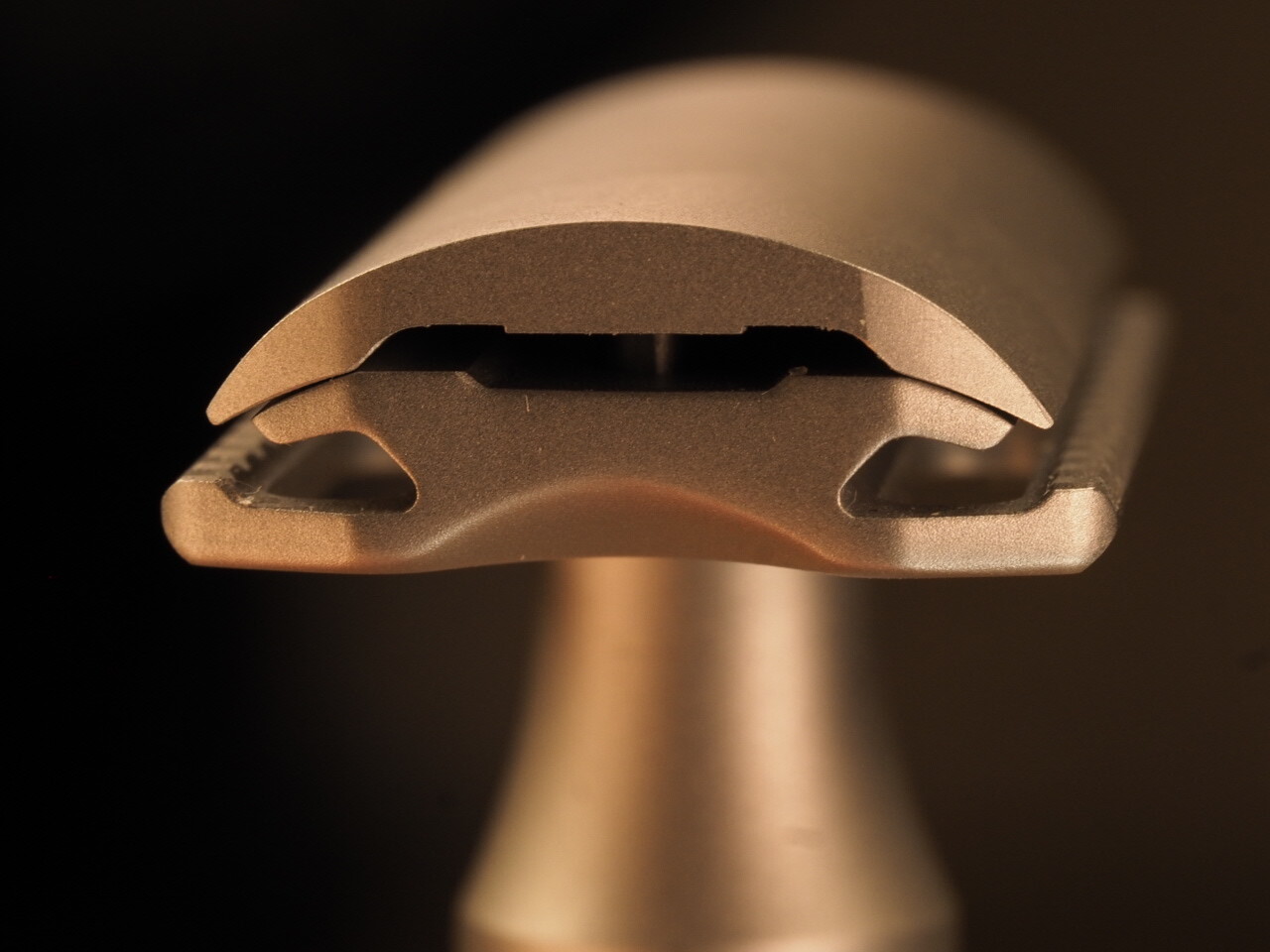
And this is the razor head of the Kämpfe Slim. I think you can see that there's a certain amount of inspiration drawn from the Timeless one. It's not a 1:1 replica. The shapes of the inner channel are rounder on the Timeless. The Kämpfe's cover protrudes slightly. The Timeless's comb is a bit higher. But what we can't doubt is the strong inspiration the Chinese photocopier took from it.

This brings us to the cap, and in particular, its top portion. Due to its design, this cap appears to have a flattened center, but this isn't the case. The cap's curvature is quite uniform. The difference lies in the blade cutting height and the comb, which make the profile appear flatter than it actually is.
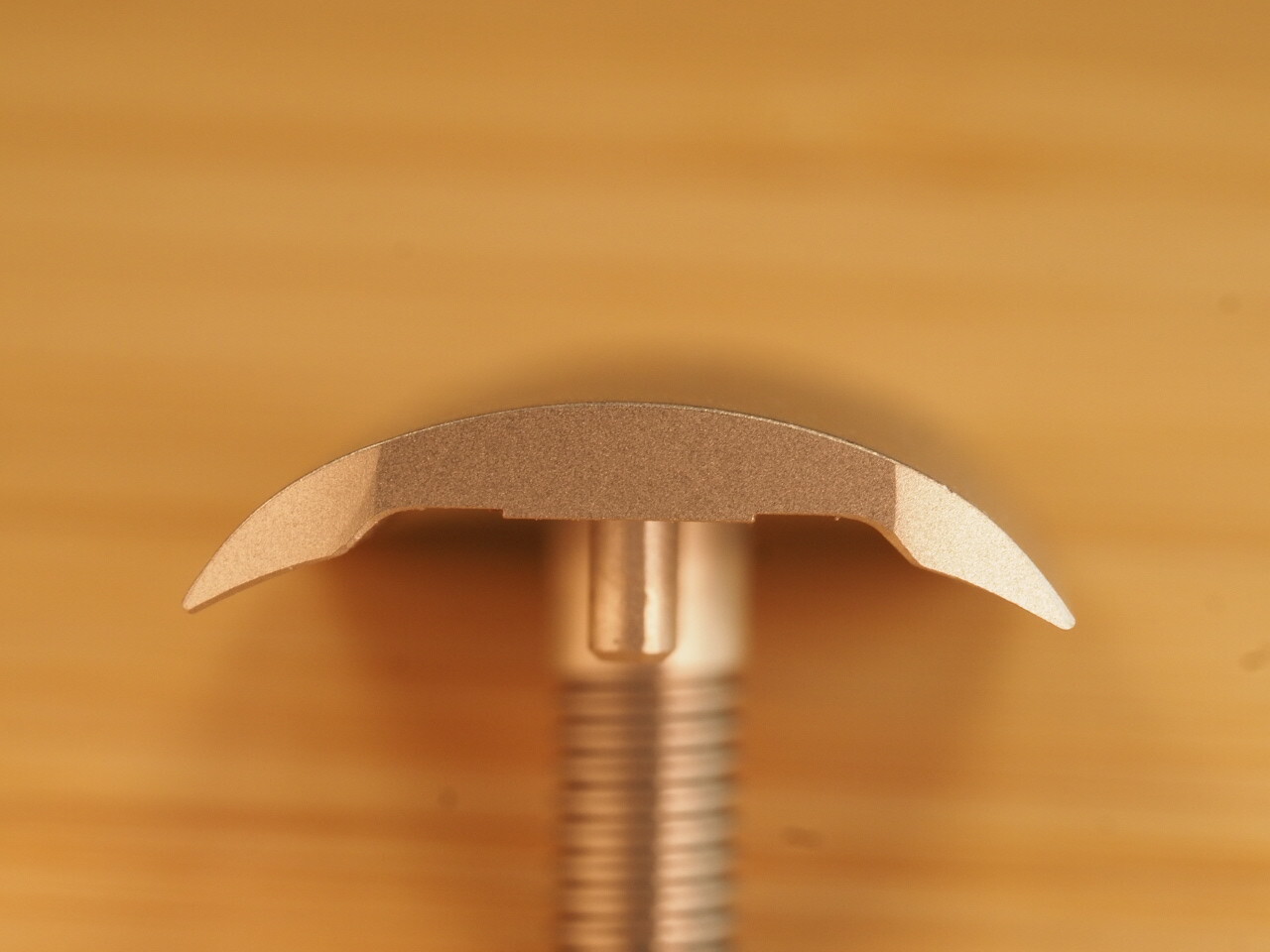
We also notice this when we measure the height of the cap. At 5 mm, it's not flat; quite the opposite. In profile, we can see the attractive half-moon shape created by the wedges that determine the final cutting angle on the sides. At the center of the cap, we see a central section which has not been hollowed out. We also see this section on the Timeless and other lids where the profile is lower due to additional mechanizing. It's simply the part where the guides and the central thread are located but by hollowing it out more, it can add a different aesthetic and reduce weight. It's not necessarily a copy, and we're not going to criticize Kämpfe for every little thing.
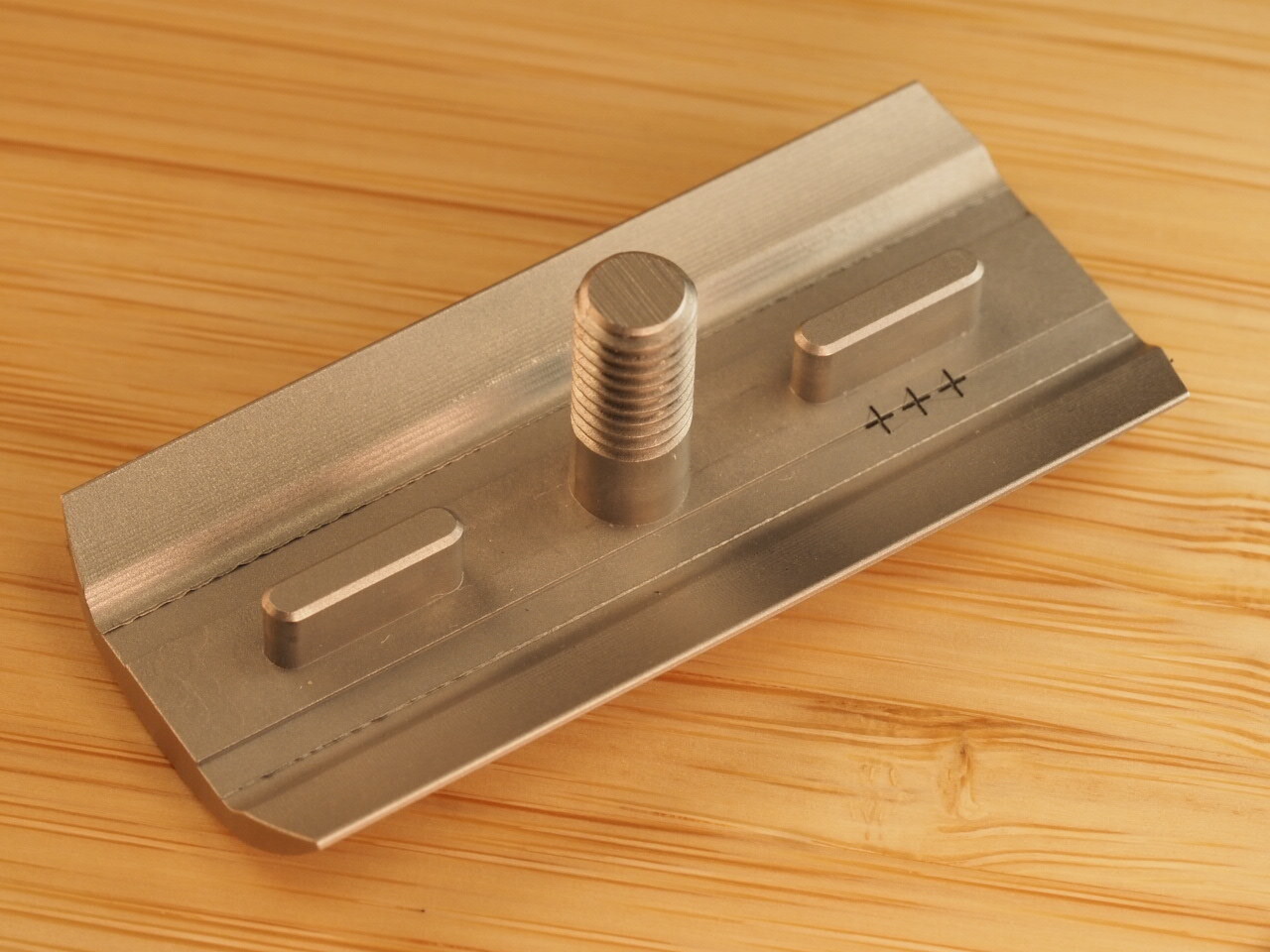
Inside the cap, we see the central section, which has the same width as the central thread. This central thread has recessed threads for a more robust connection. The guides are longitudinal and the caps’ sides are long enough to cover the blade. The corners are tapered to better fit the blade's length.

The sides where the blade is clamped are slightly concave and have lines along their surface. This concavity bends the blade slightly downwards, further reducing the cutting angle.
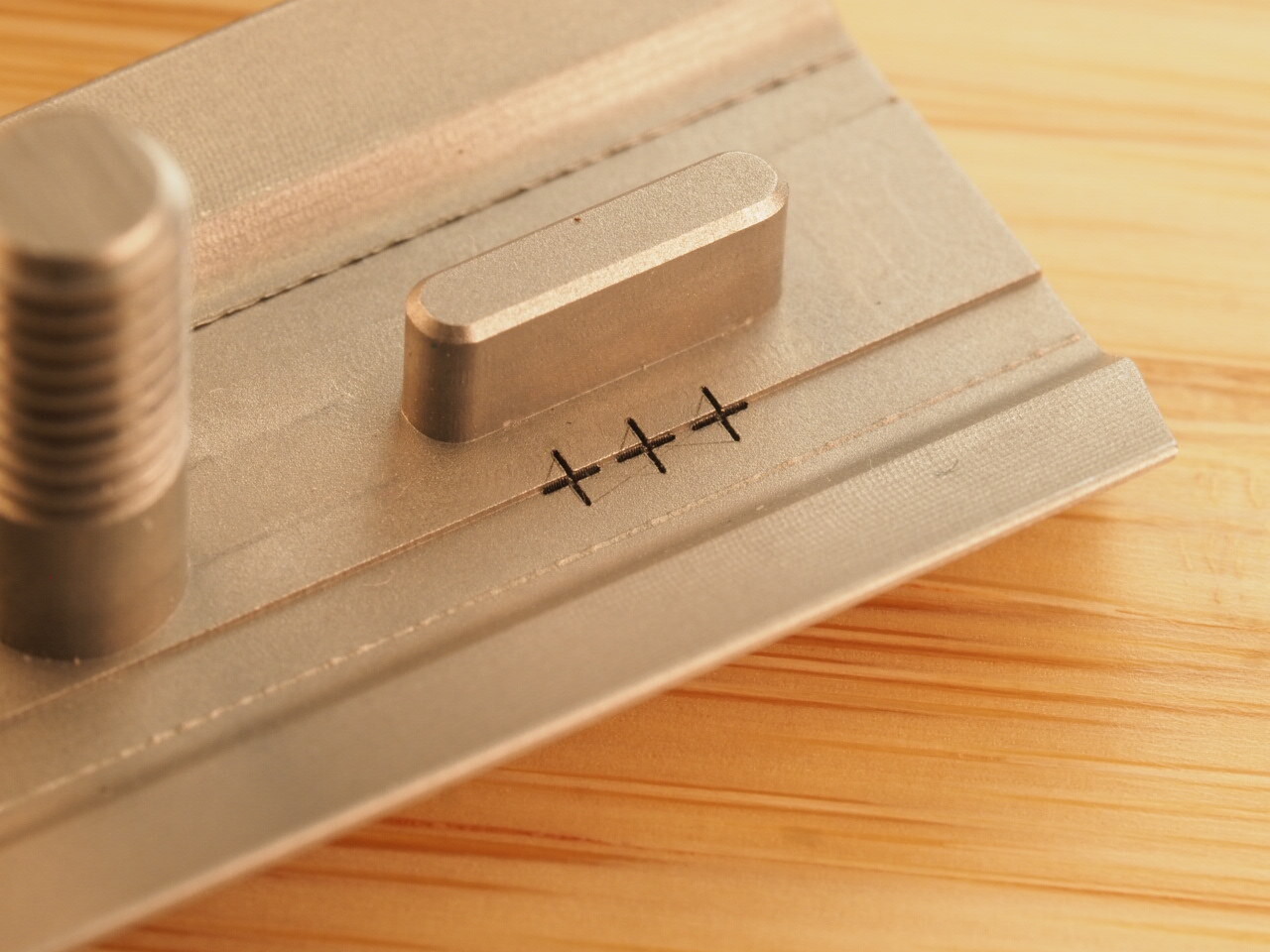
Next to one of the guides, we see the efficiency level of this razor. It's indicated with the symbol +++. This razor has a gap of 0.99 mm. There are two other versions: one with a gap of 0.68 mm (a gap also used by Timeless and Razorock…) and a gap of 0.85 mm. I assume these two gaps will have the symbols + and ++ respectively.

This efficiency symbol is also found inside the baseplate, next to one of the guide holes. If you place both pieces side by side, the +++ symbols are in the same position. A practical detail.

The holes and the edges of the side surfaces are beveled. The entire interior of the base plate is sandblasted, giving it that matte gray appearance that has proven so practical on dozens of razors over time.

The underside of the baseplate shows four rinse channels, just like the Timeless model, but that's where the similarities end. On the sides, there's a concave recess that offers a slightly more comfortable grip for holding the attached shower head. The guide holes on the Slim are open, while those on the Timeless are closed.
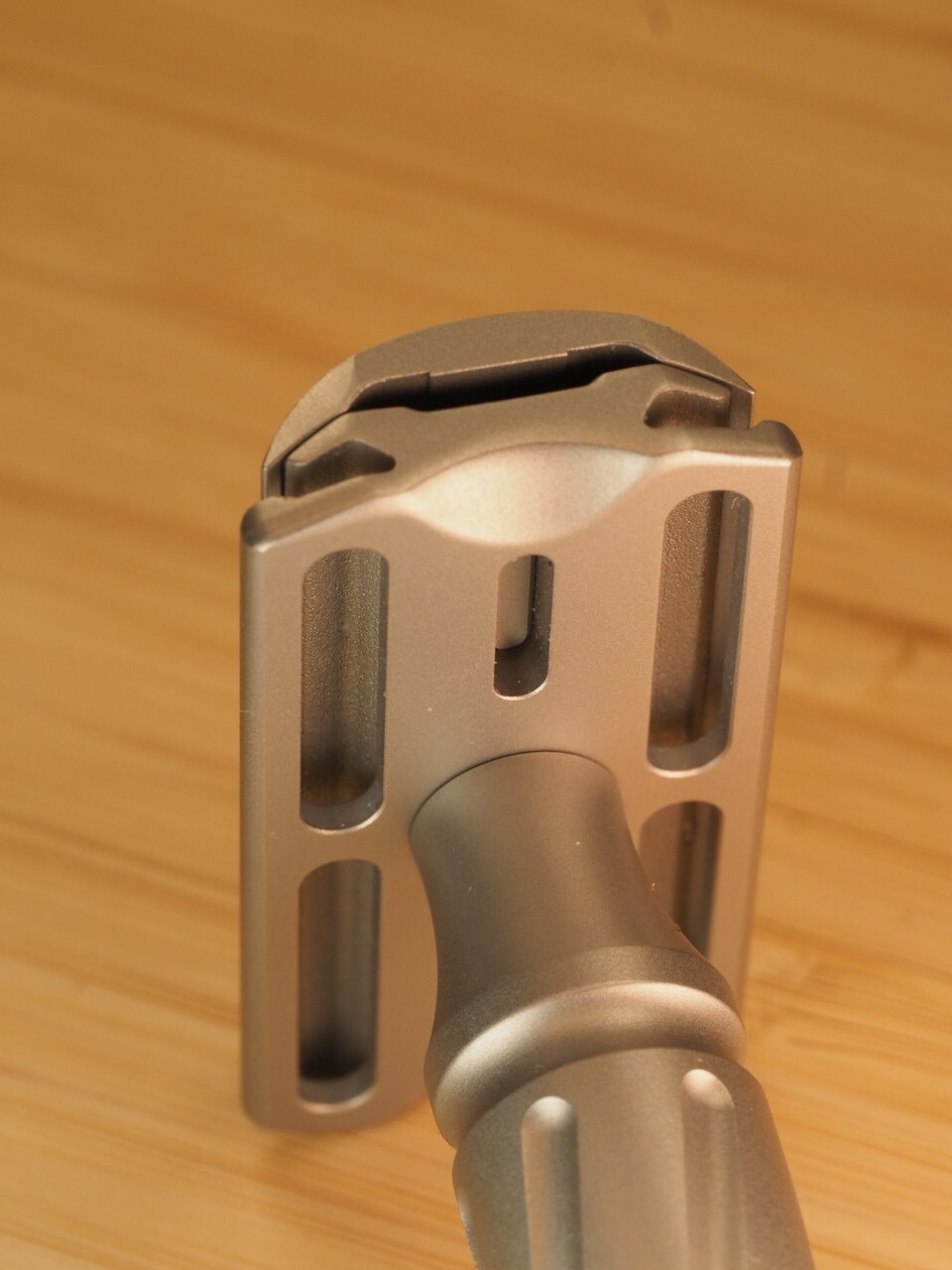
This isn't necessarily a problem, and what I'm about to mention doesn't affect the shaving experience at all. However, it does affect the aesthetics. The guides on the cover don't reach the base of the plate. They’re not flush. It would almost seem like the razor hasn’t been properly assembled.

Being as it is, it would have been more aesthetically pleasing to leave the holes closed on this side and make them blind. It would look neater. Alternatively, the guides could have been made longer so they would be flush with the plate.

We've seen that the razor head features elements from other models, but it's not a 1:1 replica. The brand name isn't identical either, but it's close. The Kämpfe brand is clearly inspired by the Kampfe brothers. Three brothers named Frederick (1851-1915), Richard (1853-1906), and Otto (1855-1932) Kampfe emigrated to the USA around 1872 and settled in New York. There, they opened a cutlery shop on Reade Street. Not much is known about the brothers' business, but we do know that in May 1880, Frederick and Otto filed a patent application, which was granted in June of that same year. They patented the very first safety razor. The first Safety Razor. To properly understand this, we need to go back in time.
In ancient times, razors (of various materials and shapes) had already been used for shaving. The razor was (and still is) an instrument that requires considerable skill to use, not only to achieve a good shave but simply to avoid cutting your jugular vein and bleeding to death. Several people recognized this problem and attempted to create solutions.
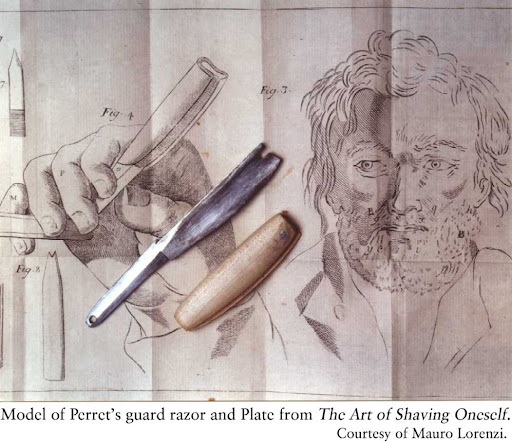
One of the first was the Frenchman Perret, who sold a wooden sheath for a traditional straight razor that was placed over the blade, leaving only a small portion of the edge exposed. This greatly reduced the risk of accidental cuts, and others continued to develop this idea.
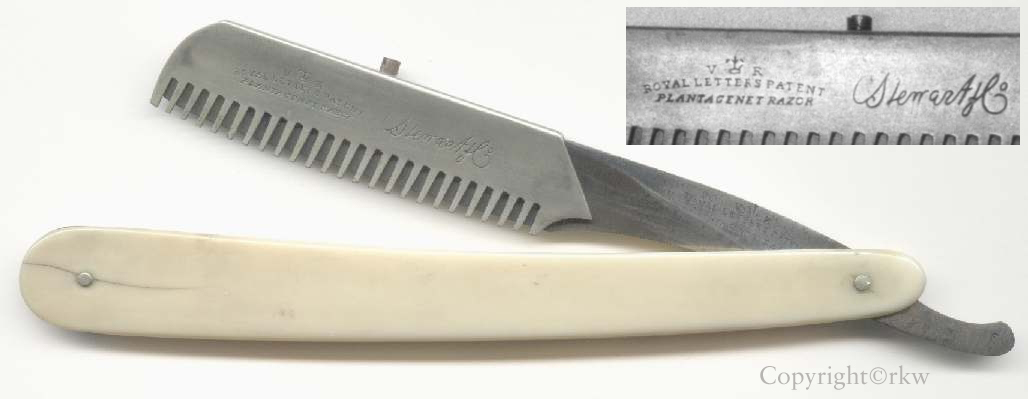
Initially, solutions were created for straight razors since those were the only tools available, but later, razors were invented that held a forged blade, similar to a straight razor but shorter, and which provided some method of reducing the unlimited cutting capacity of a bare razor’s edge.


Our esteemed William Samuel Henson (yes, the one from today's Henson safety razors, although he didn't design them) had already designed a guard for a razor very similar to what we would now call a shavette.

And Henson also has his place in history, as he was the first (obviously there's debate...) to invent a system that placed the handle perpendicular to the blade. The difference? He never called it a safety feature. The Kampfe brothers focused specifically on creating something that would exponentially increase the comfort and safety of shaving with a razor blade. The only blades available at the time were straight razors or short versions thereof. And this is what the Kampfe brothers' safety razor used. You can see the patent here (US 228904).

The drawings clearly show the construction of this razor. Figure 5 shows the different components. A handle (H) that could be unscrewed (K) and stored inside the main body for easier transport. We also see the blade (c) which was placed on top of the razor by inserting it into the four clamping supports (B). Behind the blade was a spring-loaded stop (F) that held it in place.
Figure 3 shows the front of the razor, and we can see that it had a large opening. We can also see the teeth of the open comb. In Figure 4, we can see how the blade sits directly behind the teeth of the comb. This is a configuration that we still see today in Tech-type razors with an open comb. Examples include the Lambda Ares v2, the Fatip heads, and the Mühle R41. All of these razors have a blade that rests on an open comb and cuts whatever the comb allows to pass through. The Kampfe razor worked the same way, or rather, these modern razors "imitate" Kampfe's operation.
The inner part of the razor's body was designed to collect all the lather. Part of increasing shaving comfort was also preventing soap and/or residue from getting on your hands. With this razor, everything collected by the comb and blade went inside the razor. It was then easily rinsed off with clean hands.
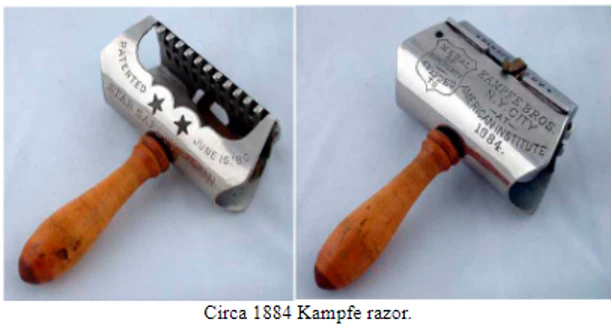
This razor was named the “Star Razor” and it truly is the first razor where safety (and comfort) is a primary feature. In 1919, the American Safety Razor Co. bought Kampfe's business and documented that the Kampfe brothers had already built their first razor in 1875. And they built many more.
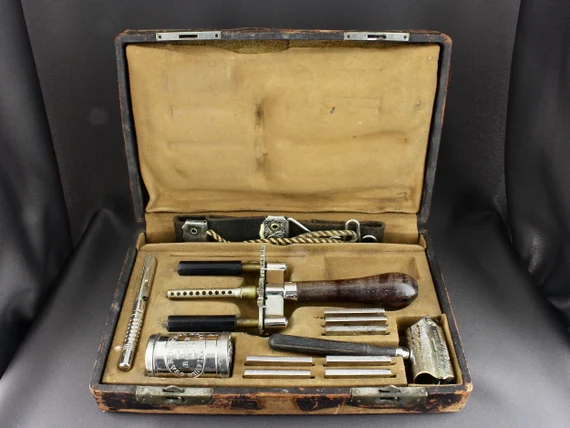
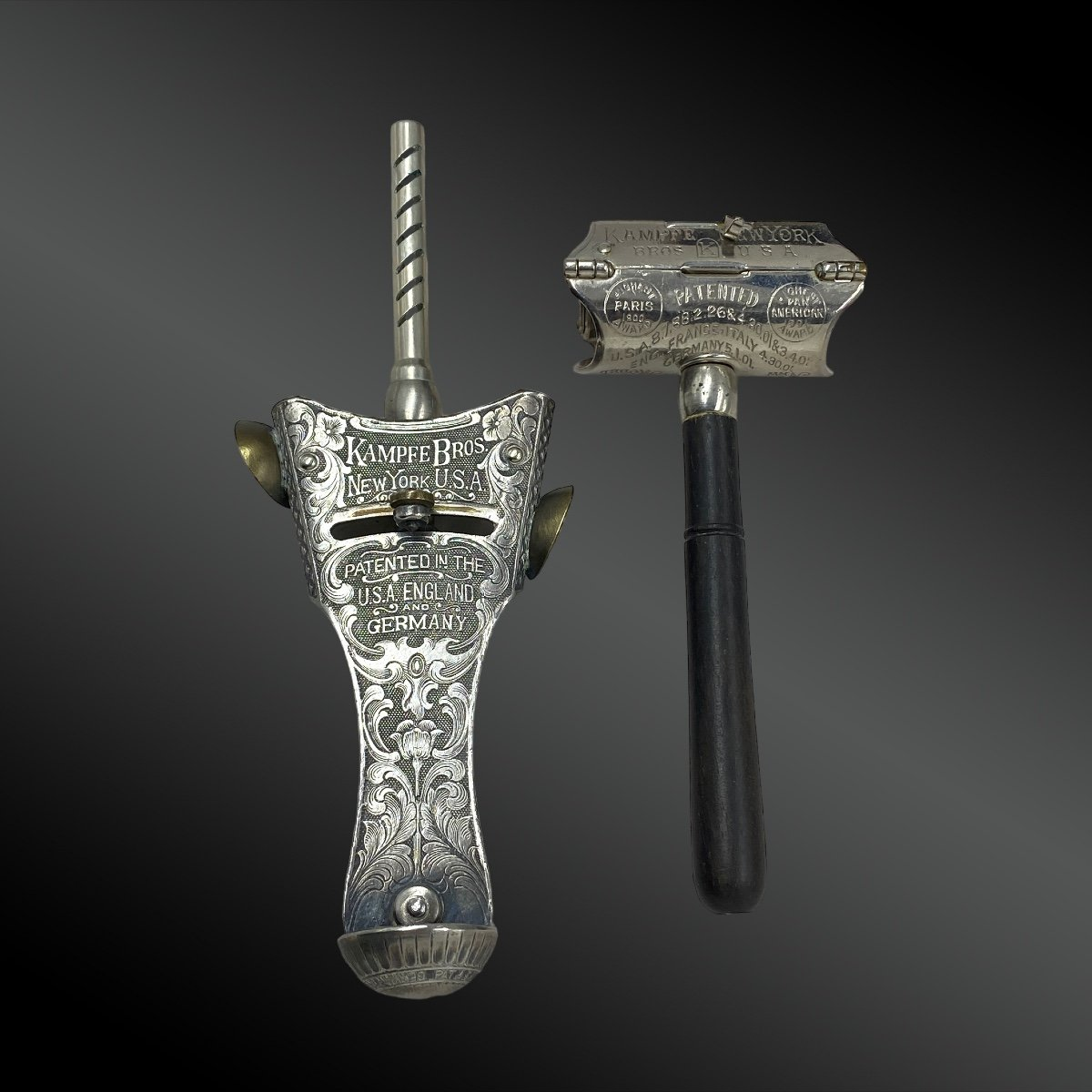
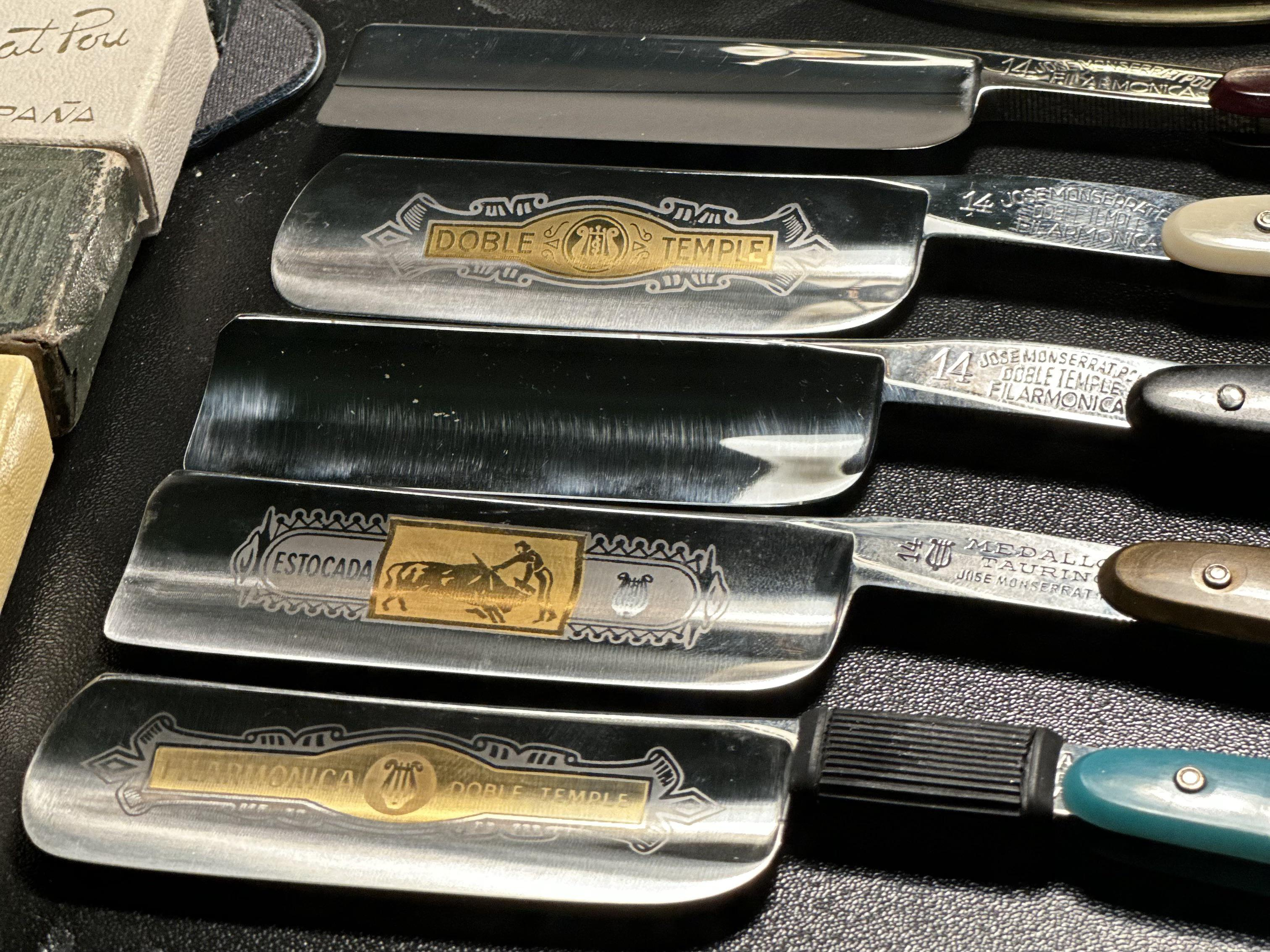
The brothers diversified their range of razors extensively. They filed for dozens of patents, which were also granted to them. And not just for safety razors. One drawback of these razors was that the blade, essentially a mini straight razor, had to be sharpened and stropped like any other straight razor. To perform this task, the Kampfe brothers created several systems. Some were automatic, others designed for greater comfort and consistency. This further increased the number of patents they obtained. Here are some of the razor models they created and some of the stropping machines they released.
In summary, we can say that King C. Gillette revolutionized the world of shaving and transformed it into what we know today. His thin, disposable and flexible double-blade razor was a game-changer in shaving and remains the foundation of the system we enjoy so much today. But the first ones to create a safety razor, very similar to the ones we use today, were the Kampfe brothers. Everything that followed was a refinement of their initial idea.


The initial patent expired in 1897 but long before then, the Star Razor had been copied by many others. They called it the American Model. The Kampfe brothers continued to distinguish themselves by offering more elaborate models with premium materials and evolving their invention with more and more patents. They even produced razors that were adjustable in various ways and created a disposable blade for greater convenience. In the end, they obtained more than 50 patents for razors, stropping mechanisms and blade sharpening systems.
Without the Kampfe brothers, the history of classic shaving would have been completely different. Their idea of offering a shaving system that anyone could use easily, cleanly and comfortably at home, without needing to be an expert barber, was revolutionary. This idea laid the foundation for the razors we know and enjoy today. Thank you, Frederick, Richard, and Otto Kampfe!
And now we have some Chinese people who have used the name Kampfe and given it an even more German touch by putting a dieresis over the 'a'. That way they can say they were "inspired" by its name when they created their brand…
Material: Stainless Steel
Finish: Matte satin polished
Handle length: 95 mm
Handle diameter: 13 mm
Total length of the razor: 103 mm
Total weight: 125 gr
Head weight: 37 gr
Cap height: 5 mm
Cap width: 19.97 mm
Gap: 0,99 mm
Exposure: neutral

The Kämpfe Slim's finish is very practical. It has a matte satin bead-blasted finish that doesn't show fingerprints. All the corners are neatly finished and don't get in the way. The edges are also finished nicely. The most defined edge is on the short side of the cap. This helps to provides a better grip when you hold the cap between your thumb and forefinger while changing the blade. It delivers defined edges there where you would want defined edges.
The two pieces of the head fit together very well. The central thread has some play in its hole, but the longitudinal guides fit very snugly snugly in their holes. This, combined with the excellent blade clamping, gives the head great internal rigidity. This is further reinforced by the beadblasted finish, but I'll discuss that later.
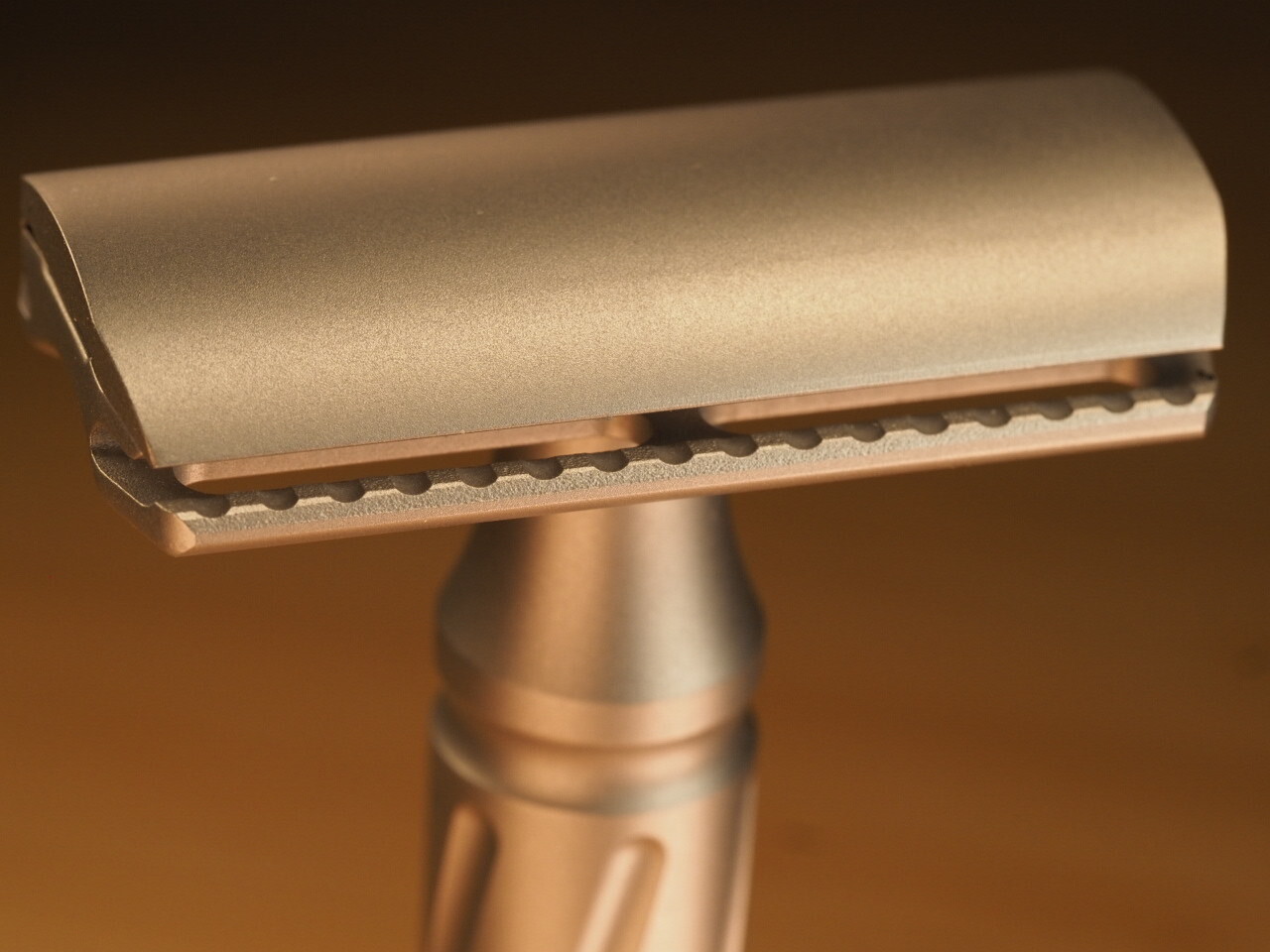
The bar rests on three supports and has grooves along its entire length. The teeth serve no practical purpose, as they are located on the inside of the comb and do not come into contact with the skin. The combination of the fine comb and the blade edge, bent (significantly) downwards, creates a unique shaving surface.

Because the blade is pointed quite a bit downwards, it resembles the shaving plane of the Henson AL13 v2. The shape of the internal channels is also similar. The position in which the head must be held for proper operation is very similar to that of the Henson.
Score: 18
Material: 4
Finish: 5
Tolerances: 4
Head/Comb Shape: 5
Grip

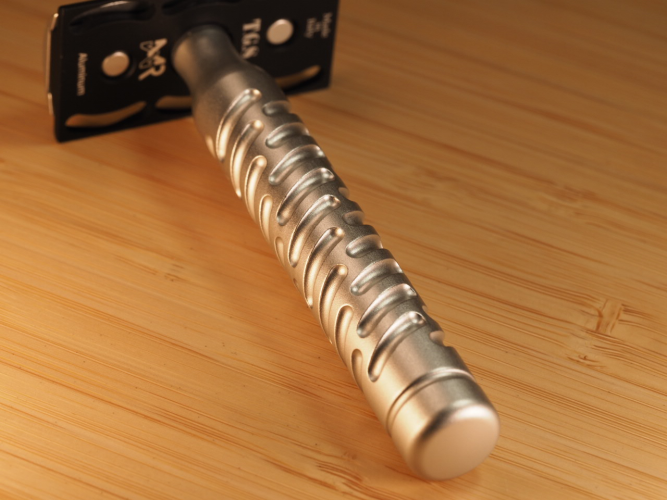
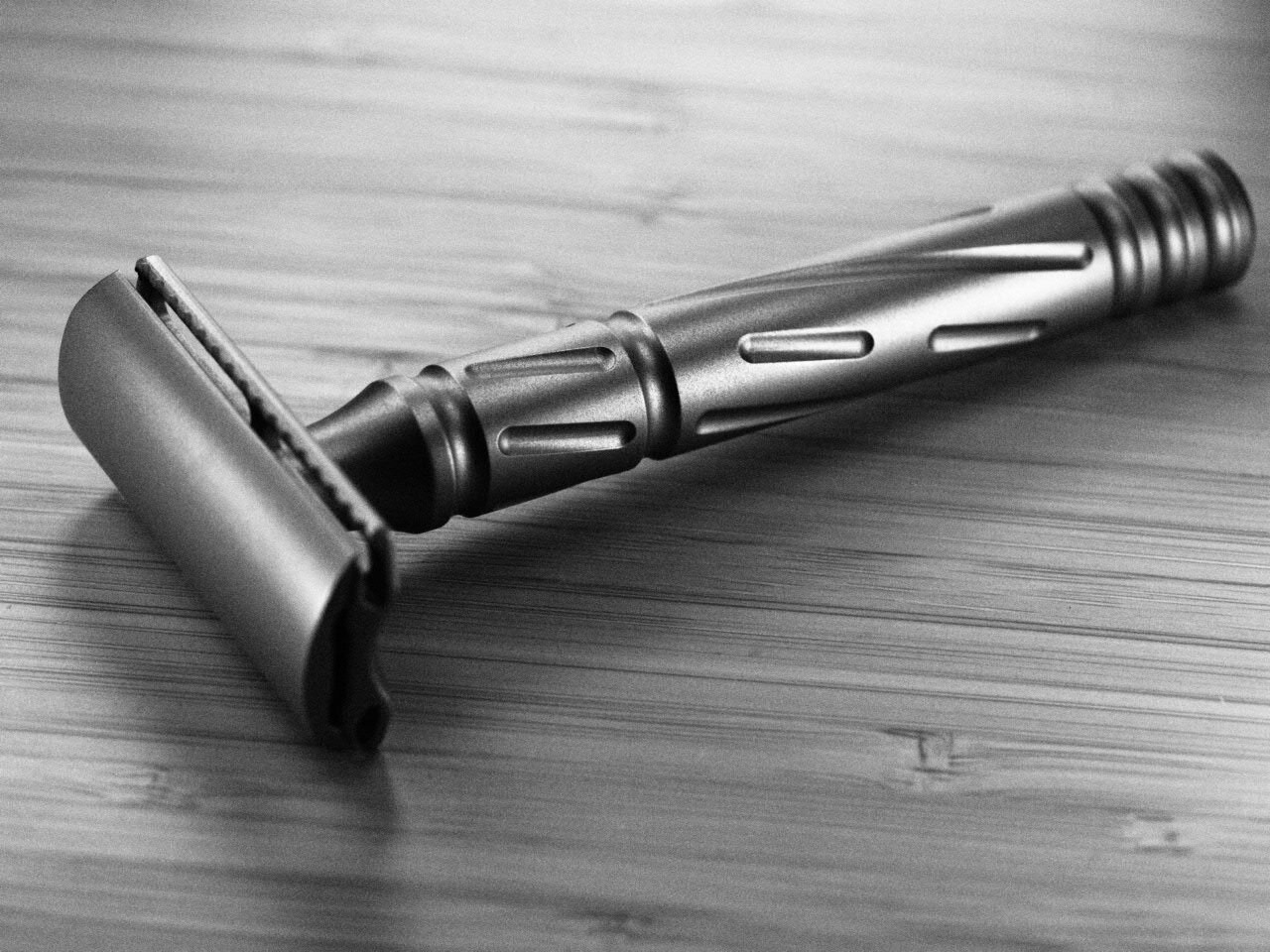
The handle is another element that might evoke memories. Its design resembles the handle of the Karve Overlander which I have also reviewed in the past. The version I reviewed was made of brass (the first difference) and had straight lines (second difference), unlike the diagonal lines of this Slim. The pommel design is also different (third difference).

This handle is made of the same material as the head and has received the same finish. This finish has a pleasant, somewhat silky feel when dry. This changes when the handle gets wet. The material's friction increases. This, combined with the milled rings on the handle and the vertical lines, provides more than enough grip.
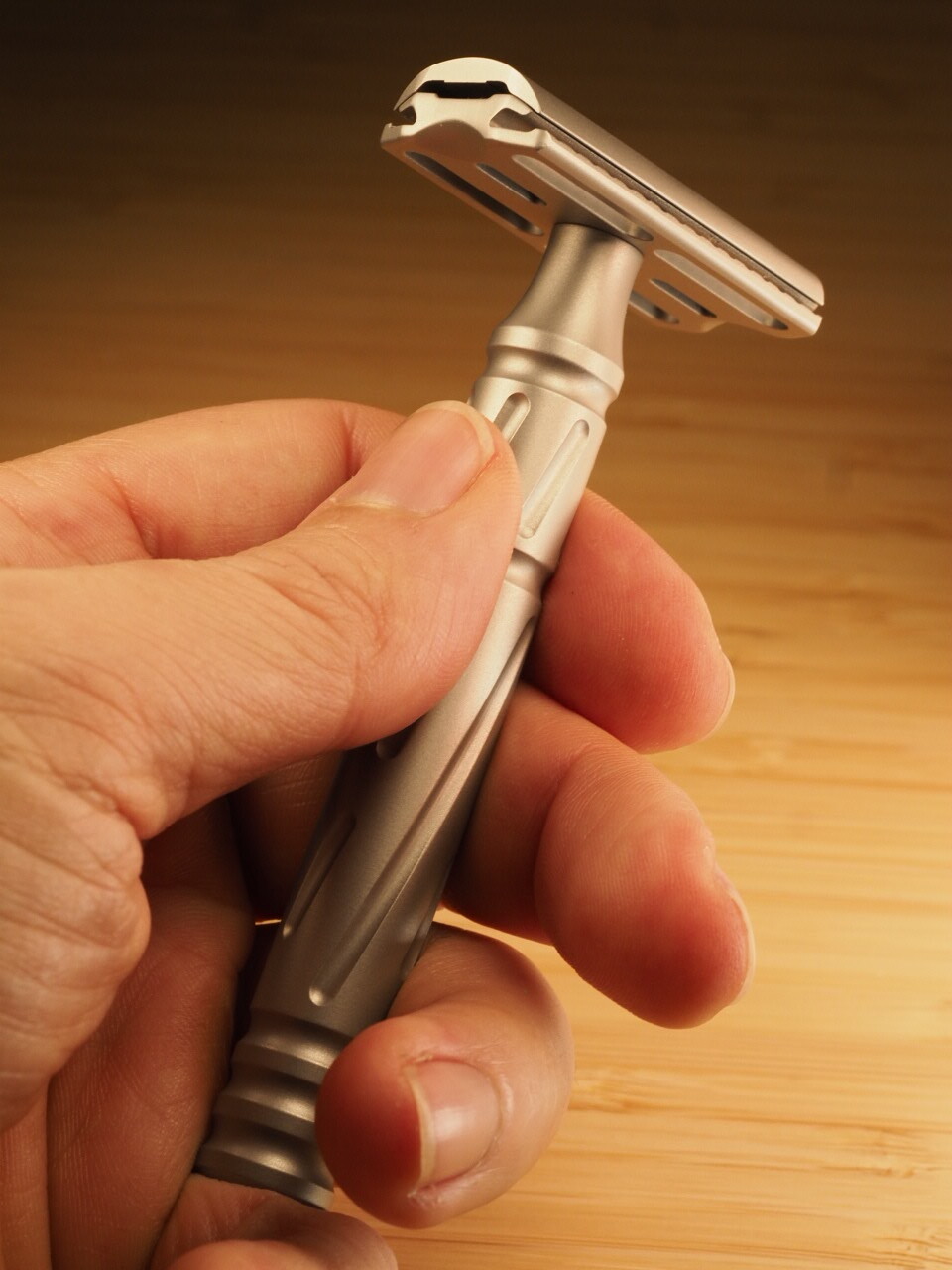
Comfort is also high. The handle length provides ample surface area for easily adopting various grips. It's long enough to rest on the pink finger and can accommodate a three-finger grip.


With the handle offering such a good grip, control over the razor is also excellent. You won't lose that control in any position. The razor's (high) weight and the (unique) shaving surface also contribute to greater control over your movements, as they reduce the speed at which you perform them.
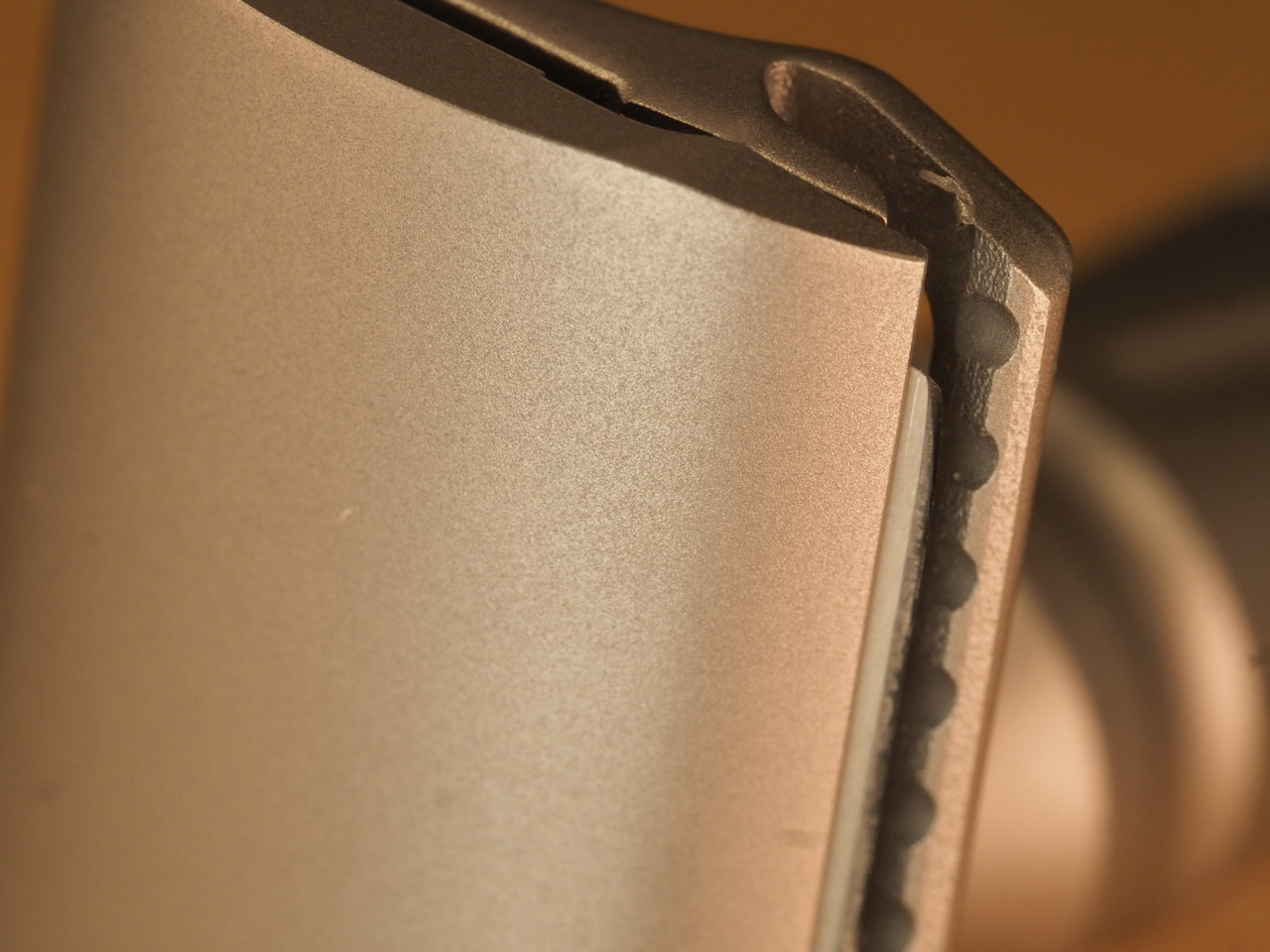

What I've described about the friction of the handle material also applies to the head. When it gets wet, the friction increases, and that affects the glide. And it's not something I would describe as positive. The glide isn't automatic. You have to move this razor intentionally; you can't just "let it fall" across your face. It generates too much friction. When you make a pass, the movement feels much more prominent. It feels like you're moving a much heavier, larger tool across your face. That's the sensation it gives because of the friction it generates.
Score: 18
Dry/Wet grip: 5
Comfort: 5
Control: 5
Head slide: 3
Handling
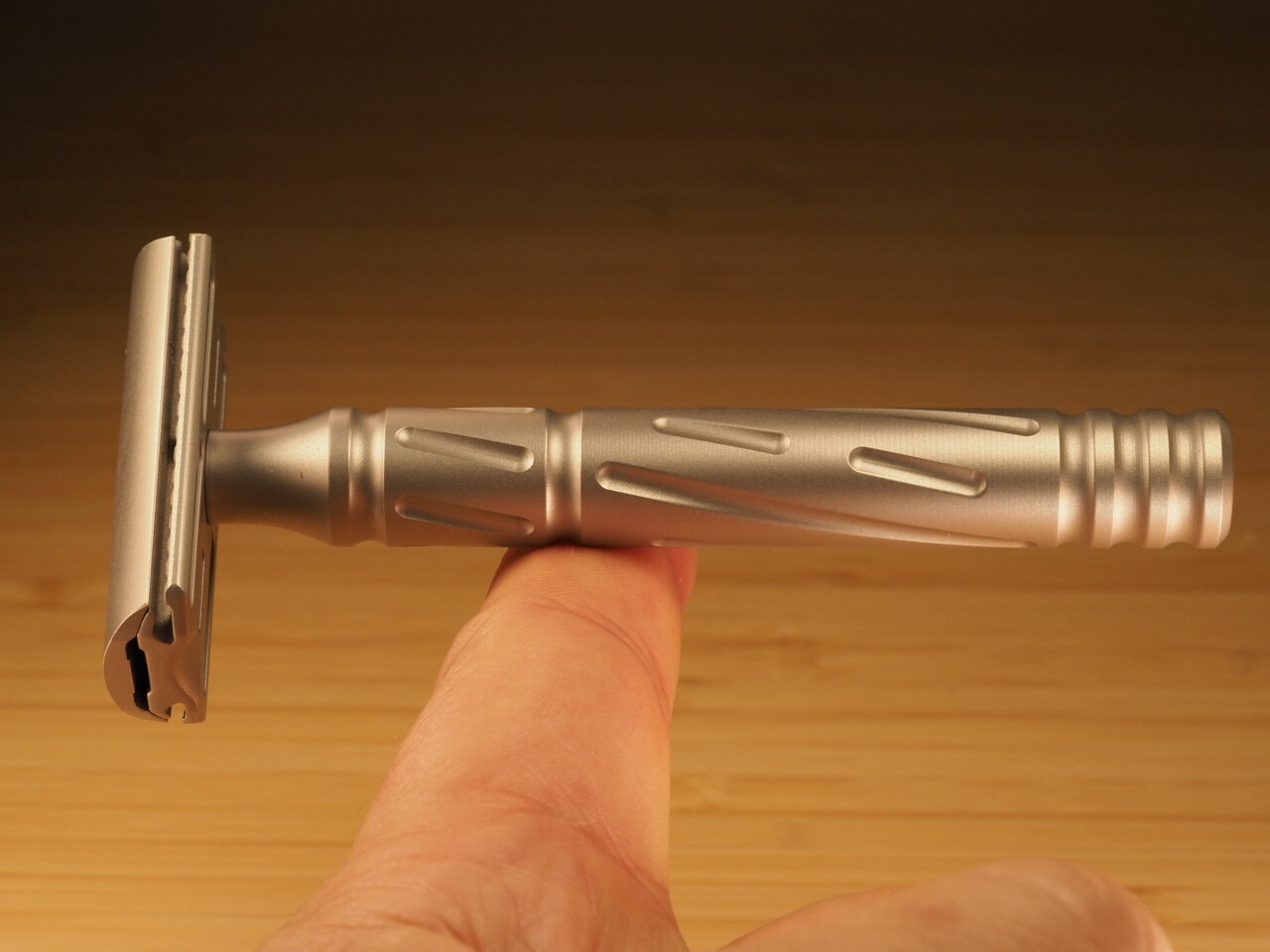
The overall balance is excellent. The balance point is precisely at the point of the intuitive grip. It's true that the razor is heavy. It weighs 125 grams in hand and you can feel that. It conveys a sense of solidity, as if you were using a razor made of an even denser material.
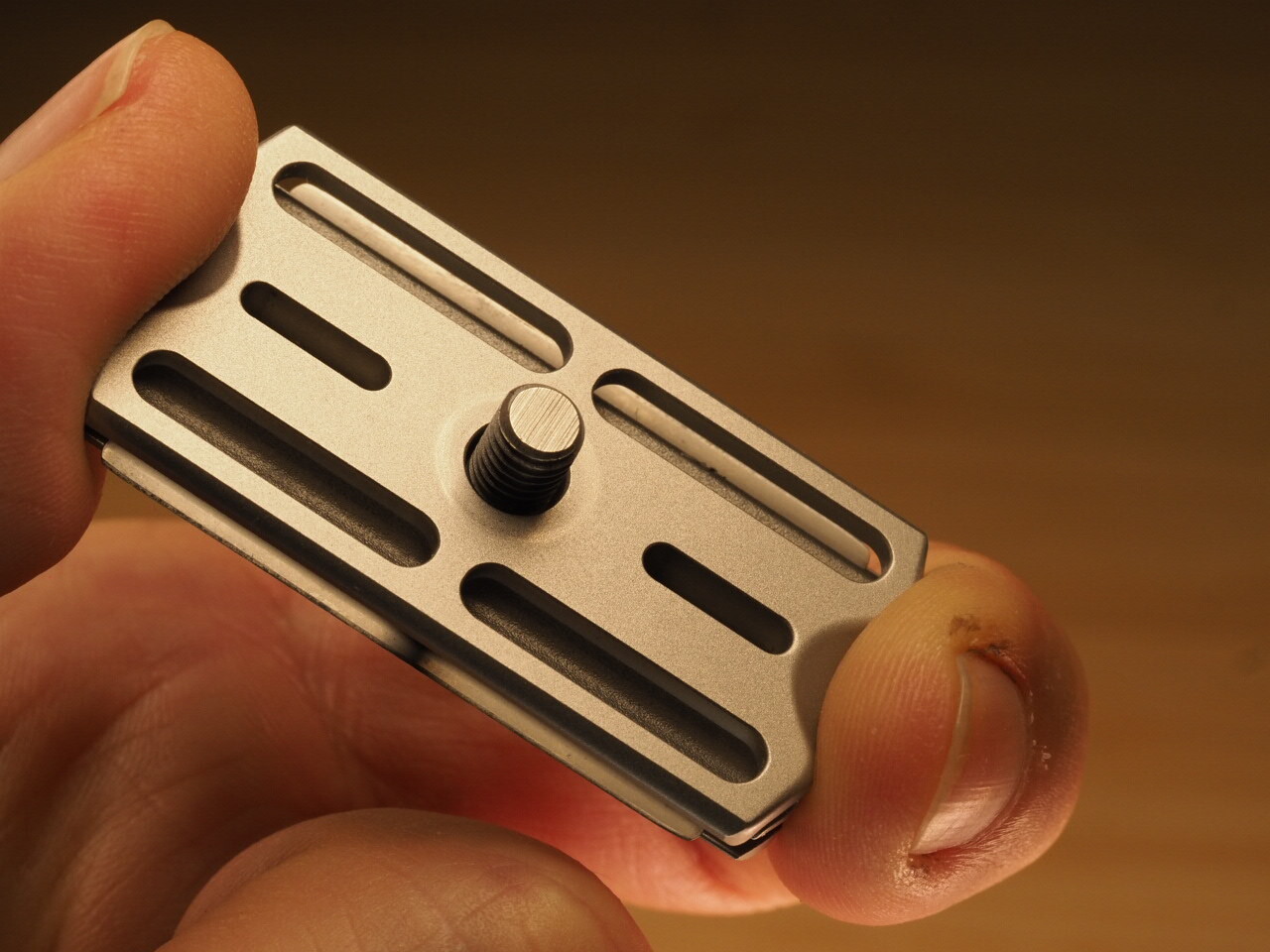
Changing the blade is easy. The cover has a good grip, the blade is easy to insert and the base plate is also easy to grip when (dis)assembling the head so you can safely (un)screw it. The added value of the concave spaces on the sides of the base plate is noticeable here. They provide extra room for your fingertips.

Cleaning is a bit more complicated. The comb's internal channel is deep and not easily accessible. Rinsing isn't a problem but it's better to run water through the side inlet rather than the two lower channels of the comb. The shaving surface quickly becomes covered in soap, and it's easier to rinse when the water enters from the side rather than from the front.
Score: 16
Balance: 5
Weight: 4
Model/Security: 4
Cleaning: 3
Shaving

I was left with mixed feelings, and it all has to do with the way the head moves across the skin. It's not a matter of gap, cutting angle or shaving plane. It has more to do with the less smooth glide and the weight of the razor. To put it simply, the weight of a razor greatly influences its performance. It largely determines how the razor moves across your skin and how easy it is to maneuver. A heavier razor isn't necessarily a bad thing. A certain weight adds a sense of quality and slows down the shaving process, allowing for a more relaxed experience.
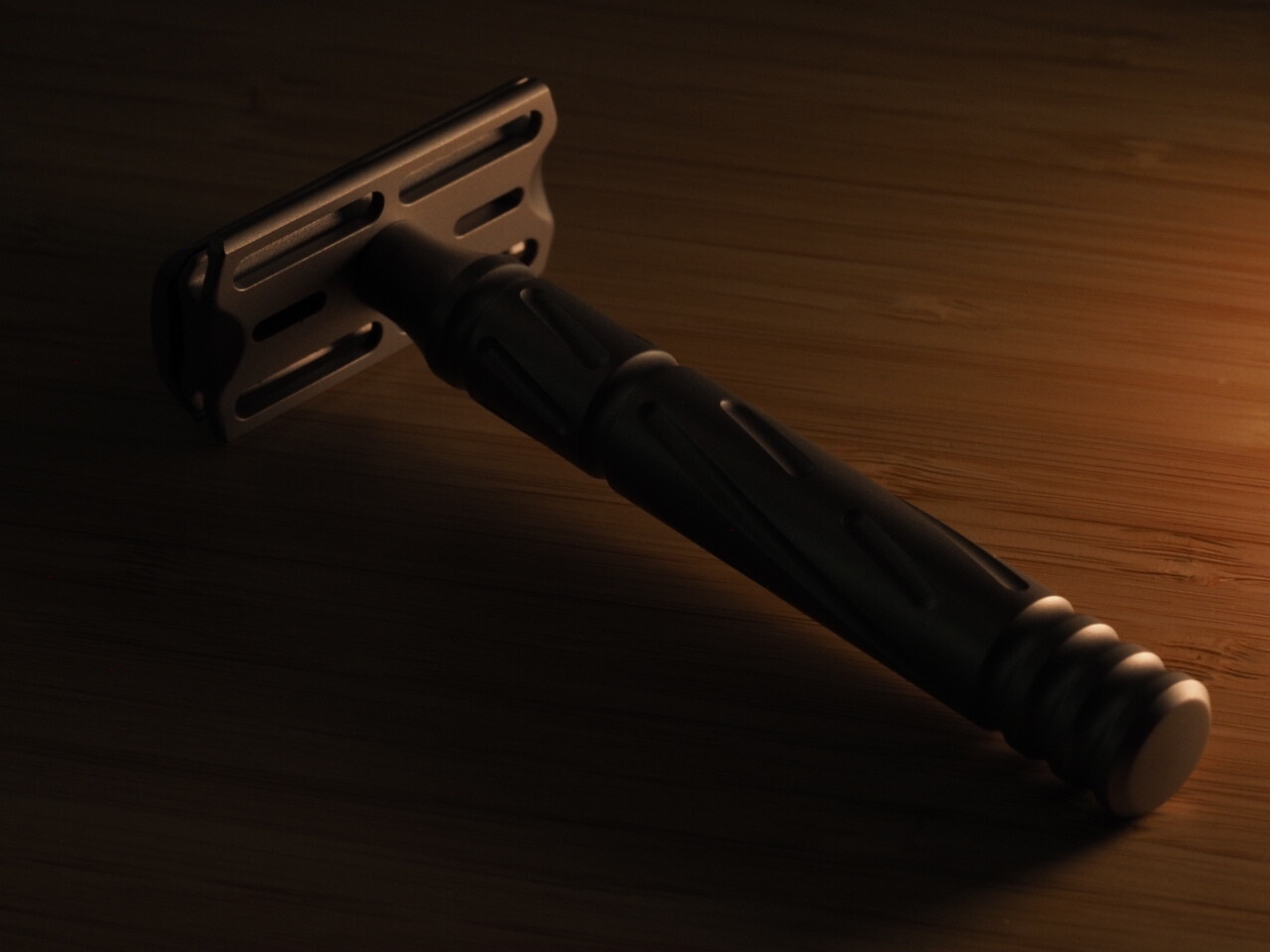
But when that considerable weight is combined with a somewhat sticky glide, the weight is amplified. You no longer just feel the weight of the razor itself, but the added friction of the material. This forces you to have a firm hand when using this razor. It doesn't just fall across your face using gravity. You have to guide it exactly where you want it to go. There can’t be any hesitation or doubt and that puts the shaving experience in a different light.
By doing that and maintaining a proper cutting angle, you can achieve good results with this razor. It has a neutral exposure and although the gap appears large, the cutting angle is small and the blade points downwards, which greatly softens its action.

Sometimes it's too soft. This razor is one of those that prefers a sharper blade to a less sharp one. I used it with a BIC (which are very sharp but somewhat rough) and got a perfect shave. However, with the Derby, I had to go over the same area several times and I could feel the blade bouncing. This wasn't due to poor clamping; quite the opposite, it was because the blade wasn't at the perfect angle for use and lacked the cutting power to compensate for that lack of precision.
The head is shaped to easily reach any area that needs shaving. Below the jawline, you need to keep the handle slightly closer to the skin to maintain the cutting angle, but that's the only precaution. This head also covers the nostrils and reaches under the nose very well. With a configuration similar to the Henson, this razor has a forgiving nature. You won't cut yourself quickly with it. However, you should be mindful of making too many passes or touch-ups. Its smooth cut encourages multiple passes. This firmness and slow movement provide a sense of security, so be careful not to overuse it to avoid irritation.
Score: 18
Efficiency: 4
Head control: 5
Derby/blade test influences: 4
Indulgent: 5
Quality/Price

In my eyes, the razor has a practical and utilitarian aesthetic. There are versions with different handles and a different (glossy) finish, which slightly alters its appearance. I really like its industrial look but I would like it even more with a different handle. The diagonal lines don't appeal to me, and the bottom of the pommel isn't flat, so you can't stand the razor upright. The way the guides don’t sit flush is also a bit disappointing. The razor is attractive, but it could be even better with a few tweaks. This razor isn't one of the cheapest on AliExpress. The last time I checked, the price was around 80 Euros. That's a considerable price, but we're also talking about a razor with an interesting stainless steel design. I think the price is justifiable considering what you get in return, but it goes into bargain territory if the price can be reduced a bit more during sales.

Kämpfe razors are mass-produced and I don't think this razor will maintain its retail price for a quarter of a century. Prices will come down inevitably.
Could I live with this razor for the rest of my life? The short answer is no. But there's a longer answer, of course. One of my top priorities—you could almost call it a necessity—is being able to move a razor comfortably, safely and smoothly across my skin. And with this one, that wasn't always the case. I blame the head’s finish but it's more than that. The weight exacerbates the problem and the unusual cutting angle doesn't lessen the feeling.

I have to say that these are just my impressions and it's not necessarily a bad razor. The ratings for the different components are good and this razor shaves well. But it's not the most intuitive at doing so.
Score: 11
Aesthetics: 4
Reward: 4
Value in 25: 2
Single razor: 1
Conclusion
Before I finish, I want to thank my friend @vicentej for lending me this razor for the review. @vicentej has lent me countless razors, and I'm incredibly grateful. Thanks a million, Vicente!
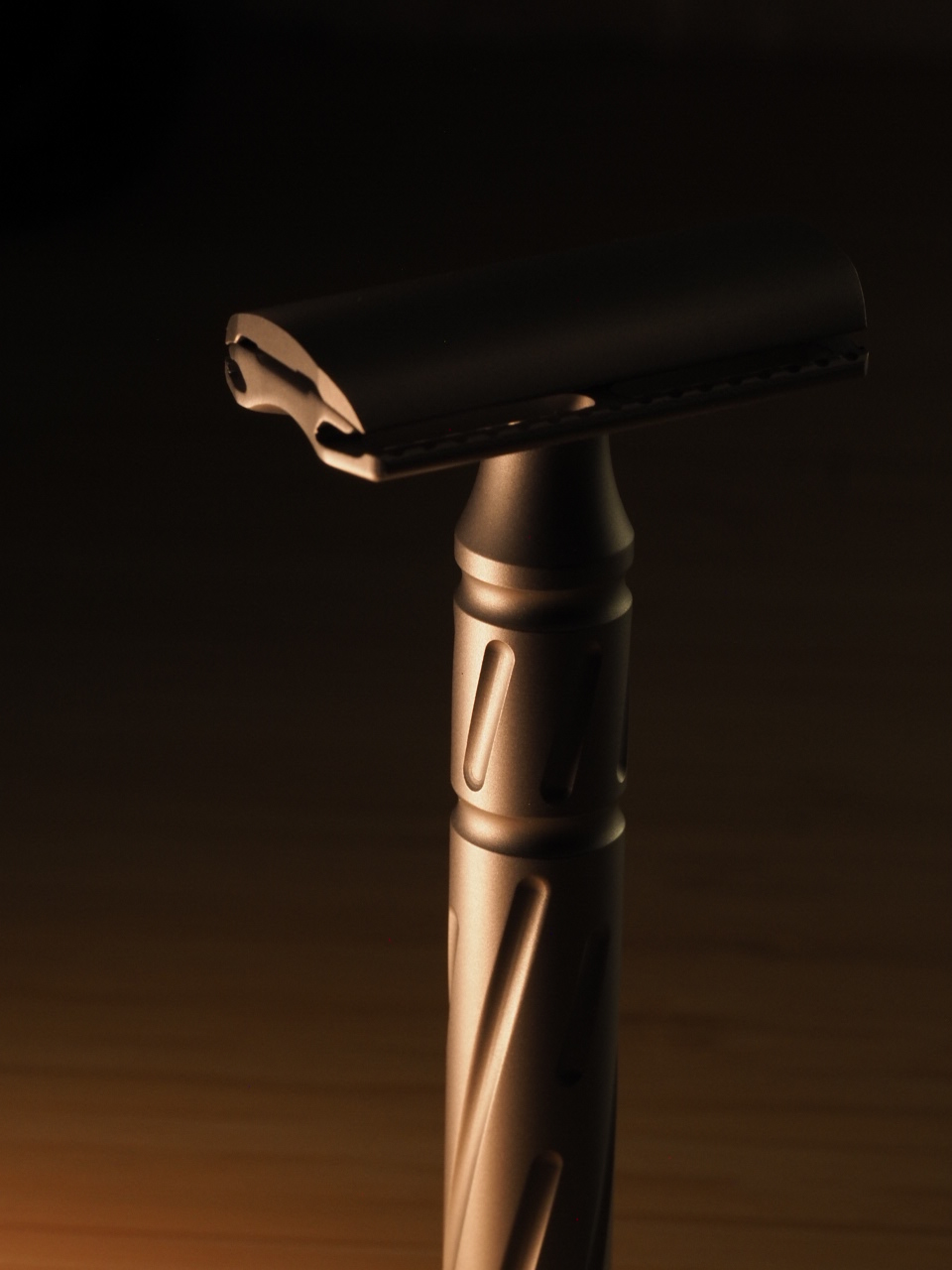
Kämpfe has created a razor that offers ease of use and a safe shave. This is perfectly in line with the Kämpfe brothers' company philosophy. They've created a razor with a terrible name but based on tried and true elements that have worked well in other situations.
Are they inspirations? Well, yes, in some pieces we see similarities with other razors and in this case, even the brand name is inspired by three brothers. But we also have to be realistic and conclude that a razor, reduced to its basics, is a blade held by a head that has a handle for use.

And within that range, all the razors we analyze in these reviews are identical. Some have an open comb, others a longer handle and still others are made from humble or premium materials. But they all aim to offer the same thing: a comfortable and safe shave with a blade. Exactly as the Kampfe brothers intended.
Final score 81 points
Introduction
There was a time in China when no one cared if trademarked names were used on products not manufactured by the company in question. In other words, it was acceptable for Chinese-made copies of other companies' products to be manufactured and sold under those other companies' names without a license. These are the classic knock-offs we've always seen from street vendors on the beaches: the crocodile polo shirts, the watches with the crown logo, and the handbags with the intertwined L and V.
This practice has now also extended to the realm of razors. With the globalization of markets and the growth of the internet and mega-sales platforms, these products can be sold directly to consumers, significantly reducing the controls that can be exercised over these sales. I will not delve into that topic in this review but feel free to comment as I believe it is an interesting subject to discuss.
What I will discuss is the Kämpfe brand. This brand was created and sells its products through the AliExpress platform. Before this brand existed, razors "inspired" by other models bore the names and logos of the registered trademarks. Since Kämpfe entered the scene, razors now carry the Kämpfe name instead of the original brand.
Today we'll be reviewing the model with the inspiring and eloquent name of 30St11-F11X. I'll call it Slim to make my writing process a little more enjoyable than having to repeat that cryptic name several times.
This Kämpfe Slim is a relatively original razor, but with recognizable elements. Elements that could be seen as inspirations, but since everything in the world of shaving has already been invented, we can't conclude that this razor is a pure copy. I won't treat it as such, although I will explain the elements I've noticed and focus specifically on its name. The brand name, not the one that resembles a robot's identification from the Star Wars saga. Let's analyze the Kämpfe Slim!
Construction
This Slim is a three-piece DE razor made of stainless steel using CNC machining. The seller doesn't specify anywhere on their website what type of stainless steel was used, so I won't specify it either. I don't have the expertise nor the tools to perform a metallurgical analysis to determine it. What we can conclude is that this material has a certain density that influences its weight, and a certain hardness and corrosion resistance that influences its durability. Razors made of this material will typically outlast any user.
Before we begin analyzing the razor head, I want to explain why I've nicknamed this razor "Slim." As always, a picture is worth a thousand words.
In this photo, you can see the Timeless razor head in its Slim configuration. It's a flatter head than their other models, with a reduced gap of 0.5 mm. Because of its smaller size, Timeless named it Slim. Despite being flatter, the Timeless Slim follows the same design as the other razor heads in this series. It has two channels behind the bars to hold lather for rinsing and above these channels are the surfaces where the blade rests and is secured. A very recognizable design.
And this is the razor head of the Kämpfe Slim. I think you can see that there's a certain amount of inspiration drawn from the Timeless one. It's not a 1:1 replica. The shapes of the inner channel are rounder on the Timeless. The Kämpfe's cover protrudes slightly. The Timeless's comb is a bit higher. But what we can't doubt is the strong inspiration the Chinese photocopier took from it.
This brings us to the cap, and in particular, its top portion. Due to its design, this cap appears to have a flattened center, but this isn't the case. The cap's curvature is quite uniform. The difference lies in the blade cutting height and the comb, which make the profile appear flatter than it actually is.
We also notice this when we measure the height of the cap. At 5 mm, it's not flat; quite the opposite. In profile, we can see the attractive half-moon shape created by the wedges that determine the final cutting angle on the sides. At the center of the cap, we see a central section which has not been hollowed out. We also see this section on the Timeless and other lids where the profile is lower due to additional mechanizing. It's simply the part where the guides and the central thread are located but by hollowing it out more, it can add a different aesthetic and reduce weight. It's not necessarily a copy, and we're not going to criticize Kämpfe for every little thing.
Inside the cap, we see the central section, which has the same width as the central thread. This central thread has recessed threads for a more robust connection. The guides are longitudinal and the caps’ sides are long enough to cover the blade. The corners are tapered to better fit the blade's length.
The sides where the blade is clamped are slightly concave and have lines along their surface. This concavity bends the blade slightly downwards, further reducing the cutting angle.
Next to one of the guides, we see the efficiency level of this razor. It's indicated with the symbol +++. This razor has a gap of 0.99 mm. There are two other versions: one with a gap of 0.68 mm (a gap also used by Timeless and Razorock…) and a gap of 0.85 mm. I assume these two gaps will have the symbols + and ++ respectively.
This efficiency symbol is also found inside the baseplate, next to one of the guide holes. If you place both pieces side by side, the +++ symbols are in the same position. A practical detail.
The holes and the edges of the side surfaces are beveled. The entire interior of the base plate is sandblasted, giving it that matte gray appearance that has proven so practical on dozens of razors over time.
The underside of the baseplate shows four rinse channels, just like the Timeless model, but that's where the similarities end. On the sides, there's a concave recess that offers a slightly more comfortable grip for holding the attached shower head. The guide holes on the Slim are open, while those on the Timeless are closed.
This isn't necessarily a problem, and what I'm about to mention doesn't affect the shaving experience at all. However, it does affect the aesthetics. The guides on the cover don't reach the base of the plate. They’re not flush. It would almost seem like the razor hasn’t been properly assembled.
Being as it is, it would have been more aesthetically pleasing to leave the holes closed on this side and make them blind. It would look neater. Alternatively, the guides could have been made longer so they would be flush with the plate.
We've seen that the razor head features elements from other models, but it's not a 1:1 replica. The brand name isn't identical either, but it's close. The Kämpfe brand is clearly inspired by the Kampfe brothers. Three brothers named Frederick (1851-1915), Richard (1853-1906), and Otto (1855-1932) Kampfe emigrated to the USA around 1872 and settled in New York. There, they opened a cutlery shop on Reade Street. Not much is known about the brothers' business, but we do know that in May 1880, Frederick and Otto filed a patent application, which was granted in June of that same year. They patented the very first safety razor. The first Safety Razor. To properly understand this, we need to go back in time.
In ancient times, razors (of various materials and shapes) had already been used for shaving. The razor was (and still is) an instrument that requires considerable skill to use, not only to achieve a good shave but simply to avoid cutting your jugular vein and bleeding to death. Several people recognized this problem and attempted to create solutions.
One of the first was the Frenchman Perret, who sold a wooden sheath for a traditional straight razor that was placed over the blade, leaving only a small portion of the edge exposed. This greatly reduced the risk of accidental cuts, and others continued to develop this idea.
Initially, solutions were created for straight razors since those were the only tools available, but later, razors were invented that held a forged blade, similar to a straight razor but shorter, and which provided some method of reducing the unlimited cutting capacity of a bare razor’s edge.
Our esteemed William Samuel Henson (yes, the one from today's Henson safety razors, although he didn't design them) had already designed a guard for a razor very similar to what we would now call a shavette.
And Henson also has his place in history, as he was the first (obviously there's debate...) to invent a system that placed the handle perpendicular to the blade. The difference? He never called it a safety feature. The Kampfe brothers focused specifically on creating something that would exponentially increase the comfort and safety of shaving with a razor blade. The only blades available at the time were straight razors or short versions thereof. And this is what the Kampfe brothers' safety razor used. You can see the patent here (US 228904).
The drawings clearly show the construction of this razor. Figure 5 shows the different components. A handle (H) that could be unscrewed (K) and stored inside the main body for easier transport. We also see the blade (c) which was placed on top of the razor by inserting it into the four clamping supports (B). Behind the blade was a spring-loaded stop (F) that held it in place.
Figure 3 shows the front of the razor, and we can see that it had a large opening. We can also see the teeth of the open comb. In Figure 4, we can see how the blade sits directly behind the teeth of the comb. This is a configuration that we still see today in Tech-type razors with an open comb. Examples include the Lambda Ares v2, the Fatip heads, and the Mühle R41. All of these razors have a blade that rests on an open comb and cuts whatever the comb allows to pass through. The Kampfe razor worked the same way, or rather, these modern razors "imitate" Kampfe's operation.
The inner part of the razor's body was designed to collect all the lather. Part of increasing shaving comfort was also preventing soap and/or residue from getting on your hands. With this razor, everything collected by the comb and blade went inside the razor. It was then easily rinsed off with clean hands.
This razor was named the “Star Razor” and it truly is the first razor where safety (and comfort) is a primary feature. In 1919, the American Safety Razor Co. bought Kampfe's business and documented that the Kampfe brothers had already built their first razor in 1875. And they built many more.
The brothers diversified their range of razors extensively. They filed for dozens of patents, which were also granted to them. And not just for safety razors. One drawback of these razors was that the blade, essentially a mini straight razor, had to be sharpened and stropped like any other straight razor. To perform this task, the Kampfe brothers created several systems. Some were automatic, others designed for greater comfort and consistency. This further increased the number of patents they obtained. Here are some of the razor models they created and some of the stropping machines they released.
In summary, we can say that King C. Gillette revolutionized the world of shaving and transformed it into what we know today. His thin, disposable and flexible double-blade razor was a game-changer in shaving and remains the foundation of the system we enjoy so much today. But the first ones to create a safety razor, very similar to the ones we use today, were the Kampfe brothers. Everything that followed was a refinement of their initial idea.
The initial patent expired in 1897 but long before then, the Star Razor had been copied by many others. They called it the American Model. The Kampfe brothers continued to distinguish themselves by offering more elaborate models with premium materials and evolving their invention with more and more patents. They even produced razors that were adjustable in various ways and created a disposable blade for greater convenience. In the end, they obtained more than 50 patents for razors, stropping mechanisms and blade sharpening systems.
Without the Kampfe brothers, the history of classic shaving would have been completely different. Their idea of offering a shaving system that anyone could use easily, cleanly and comfortably at home, without needing to be an expert barber, was revolutionary. This idea laid the foundation for the razors we know and enjoy today. Thank you, Frederick, Richard, and Otto Kampfe!
And now we have some Chinese people who have used the name Kampfe and given it an even more German touch by putting a dieresis over the 'a'. That way they can say they were "inspired" by its name when they created their brand…
Material: Stainless Steel
Finish: Matte satin polished
Handle length: 95 mm
Handle diameter: 13 mm
Total length of the razor: 103 mm
Total weight: 125 gr
Head weight: 37 gr
Cap height: 5 mm
Cap width: 19.97 mm
Gap: 0,99 mm
Exposure: neutral
The Kämpfe Slim's finish is very practical. It has a matte satin bead-blasted finish that doesn't show fingerprints. All the corners are neatly finished and don't get in the way. The edges are also finished nicely. The most defined edge is on the short side of the cap. This helps to provides a better grip when you hold the cap between your thumb and forefinger while changing the blade. It delivers defined edges there where you would want defined edges.
The two pieces of the head fit together very well. The central thread has some play in its hole, but the longitudinal guides fit very snugly snugly in their holes. This, combined with the excellent blade clamping, gives the head great internal rigidity. This is further reinforced by the beadblasted finish, but I'll discuss that later.
The bar rests on three supports and has grooves along its entire length. The teeth serve no practical purpose, as they are located on the inside of the comb and do not come into contact with the skin. The combination of the fine comb and the blade edge, bent (significantly) downwards, creates a unique shaving surface.
Because the blade is pointed quite a bit downwards, it resembles the shaving plane of the Henson AL13 v2. The shape of the internal channels is also similar. The position in which the head must be held for proper operation is very similar to that of the Henson.
Score: 18
Material: 4
Finish: 5
Tolerances: 4
Head/Comb Shape: 5
Grip
The handle is another element that might evoke memories. Its design resembles the handle of the Karve Overlander which I have also reviewed in the past. The version I reviewed was made of brass (the first difference) and had straight lines (second difference), unlike the diagonal lines of this Slim. The pommel design is also different (third difference).
This handle is made of the same material as the head and has received the same finish. This finish has a pleasant, somewhat silky feel when dry. This changes when the handle gets wet. The material's friction increases. This, combined with the milled rings on the handle and the vertical lines, provides more than enough grip.
Comfort is also high. The handle length provides ample surface area for easily adopting various grips. It's long enough to rest on the pink finger and can accommodate a three-finger grip.
With the handle offering such a good grip, control over the razor is also excellent. You won't lose that control in any position. The razor's (high) weight and the (unique) shaving surface also contribute to greater control over your movements, as they reduce the speed at which you perform them.
What I've described about the friction of the handle material also applies to the head. When it gets wet, the friction increases, and that affects the glide. And it's not something I would describe as positive. The glide isn't automatic. You have to move this razor intentionally; you can't just "let it fall" across your face. It generates too much friction. When you make a pass, the movement feels much more prominent. It feels like you're moving a much heavier, larger tool across your face. That's the sensation it gives because of the friction it generates.
Score: 18
Dry/Wet grip: 5
Comfort: 5
Control: 5
Head slide: 3
Handling
The overall balance is excellent. The balance point is precisely at the point of the intuitive grip. It's true that the razor is heavy. It weighs 125 grams in hand and you can feel that. It conveys a sense of solidity, as if you were using a razor made of an even denser material.
Changing the blade is easy. The cover has a good grip, the blade is easy to insert and the base plate is also easy to grip when (dis)assembling the head so you can safely (un)screw it. The added value of the concave spaces on the sides of the base plate is noticeable here. They provide extra room for your fingertips.
Cleaning is a bit more complicated. The comb's internal channel is deep and not easily accessible. Rinsing isn't a problem but it's better to run water through the side inlet rather than the two lower channels of the comb. The shaving surface quickly becomes covered in soap, and it's easier to rinse when the water enters from the side rather than from the front.
Score: 16
Balance: 5
Weight: 4
Model/Security: 4
Cleaning: 3
Shaving
I was left with mixed feelings, and it all has to do with the way the head moves across the skin. It's not a matter of gap, cutting angle or shaving plane. It has more to do with the less smooth glide and the weight of the razor. To put it simply, the weight of a razor greatly influences its performance. It largely determines how the razor moves across your skin and how easy it is to maneuver. A heavier razor isn't necessarily a bad thing. A certain weight adds a sense of quality and slows down the shaving process, allowing for a more relaxed experience.
But when that considerable weight is combined with a somewhat sticky glide, the weight is amplified. You no longer just feel the weight of the razor itself, but the added friction of the material. This forces you to have a firm hand when using this razor. It doesn't just fall across your face using gravity. You have to guide it exactly where you want it to go. There can’t be any hesitation or doubt and that puts the shaving experience in a different light.
By doing that and maintaining a proper cutting angle, you can achieve good results with this razor. It has a neutral exposure and although the gap appears large, the cutting angle is small and the blade points downwards, which greatly softens its action.
Sometimes it's too soft. This razor is one of those that prefers a sharper blade to a less sharp one. I used it with a BIC (which are very sharp but somewhat rough) and got a perfect shave. However, with the Derby, I had to go over the same area several times and I could feel the blade bouncing. This wasn't due to poor clamping; quite the opposite, it was because the blade wasn't at the perfect angle for use and lacked the cutting power to compensate for that lack of precision.
The head is shaped to easily reach any area that needs shaving. Below the jawline, you need to keep the handle slightly closer to the skin to maintain the cutting angle, but that's the only precaution. This head also covers the nostrils and reaches under the nose very well. With a configuration similar to the Henson, this razor has a forgiving nature. You won't cut yourself quickly with it. However, you should be mindful of making too many passes or touch-ups. Its smooth cut encourages multiple passes. This firmness and slow movement provide a sense of security, so be careful not to overuse it to avoid irritation.
Score: 18
Efficiency: 4
Head control: 5
Derby/blade test influences: 4
Indulgent: 5
Quality/Price
In my eyes, the razor has a practical and utilitarian aesthetic. There are versions with different handles and a different (glossy) finish, which slightly alters its appearance. I really like its industrial look but I would like it even more with a different handle. The diagonal lines don't appeal to me, and the bottom of the pommel isn't flat, so you can't stand the razor upright. The way the guides don’t sit flush is also a bit disappointing. The razor is attractive, but it could be even better with a few tweaks. This razor isn't one of the cheapest on AliExpress. The last time I checked, the price was around 80 Euros. That's a considerable price, but we're also talking about a razor with an interesting stainless steel design. I think the price is justifiable considering what you get in return, but it goes into bargain territory if the price can be reduced a bit more during sales.
Kämpfe razors are mass-produced and I don't think this razor will maintain its retail price for a quarter of a century. Prices will come down inevitably.
Could I live with this razor for the rest of my life? The short answer is no. But there's a longer answer, of course. One of my top priorities—you could almost call it a necessity—is being able to move a razor comfortably, safely and smoothly across my skin. And with this one, that wasn't always the case. I blame the head’s finish but it's more than that. The weight exacerbates the problem and the unusual cutting angle doesn't lessen the feeling.
I have to say that these are just my impressions and it's not necessarily a bad razor. The ratings for the different components are good and this razor shaves well. But it's not the most intuitive at doing so.
Score: 11
Aesthetics: 4
Reward: 4
Value in 25: 2
Single razor: 1
Conclusion
Before I finish, I want to thank my friend @vicentej for lending me this razor for the review. @vicentej has lent me countless razors, and I'm incredibly grateful. Thanks a million, Vicente!
Kämpfe has created a razor that offers ease of use and a safe shave. This is perfectly in line with the Kämpfe brothers' company philosophy. They've created a razor with a terrible name but based on tried and true elements that have worked well in other situations.
Are they inspirations? Well, yes, in some pieces we see similarities with other razors and in this case, even the brand name is inspired by three brothers. But we also have to be realistic and conclude that a razor, reduced to its basics, is a blade held by a head that has a handle for use.
And within that range, all the razors we analyze in these reviews are identical. Some have an open comb, others a longer handle and still others are made from humble or premium materials. But they all aim to offer the same thing: a comfortable and safe shave with a blade. Exactly as the Kampfe brothers intended.
Final score 81 points