
This review is about the Merkur 34C Edition 1896

Introduction
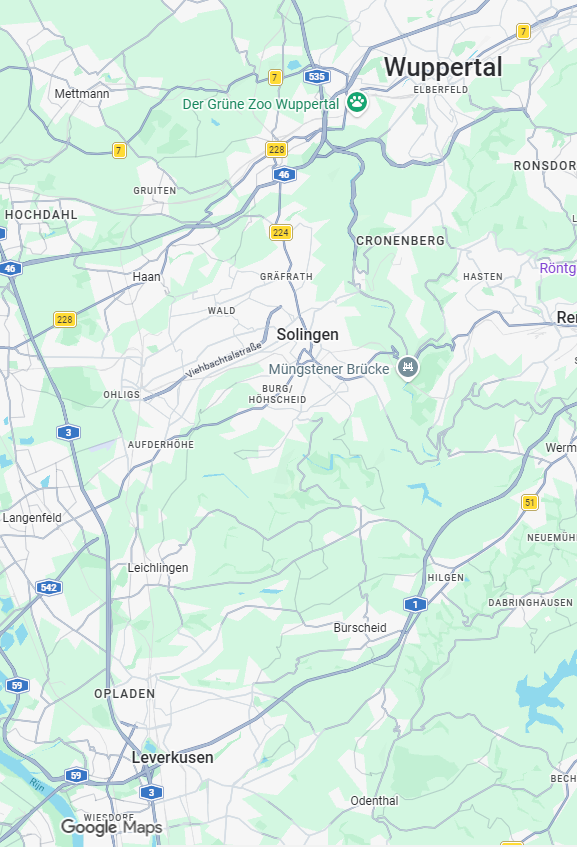
The Merkur brand is a classic in Solingen, a city in North Rhine-Westphalia located between Leverkusen and Wuppertal. This city has a protected designation of origin since 1938 and a long tradition of cutting tools. Naturally, razors and safety razors are also part of their offerings. The company was founded in 1896 by Emil Hermes, who couldn't use his surname because it was already registered. Instead, he used the Roman version of the Greek god Hermes, Mercury (Merkur). I've already told you this story in other reviews of Merkur razors but it's still worth repeating because it's the company's origin.

And after more than 125 years in the shaving market, Merkur is releasing several stainless steel versions of iconic razors from its catalog. The most iconic of these razors is the Merkur 34C, which this time is called the Edition 1896. This is the razor we'll be reviewing.

We all know the zinc alloy version, a version with a utilitarian design that's comfortable to use, safe and forgiving. One might assume that the same razor made of stainless steel would be identical to its older sibling but that would be a mistake. There are quite a few differences between the two razors, which we'll go over in this review... and not all of them are for the better...
Construction
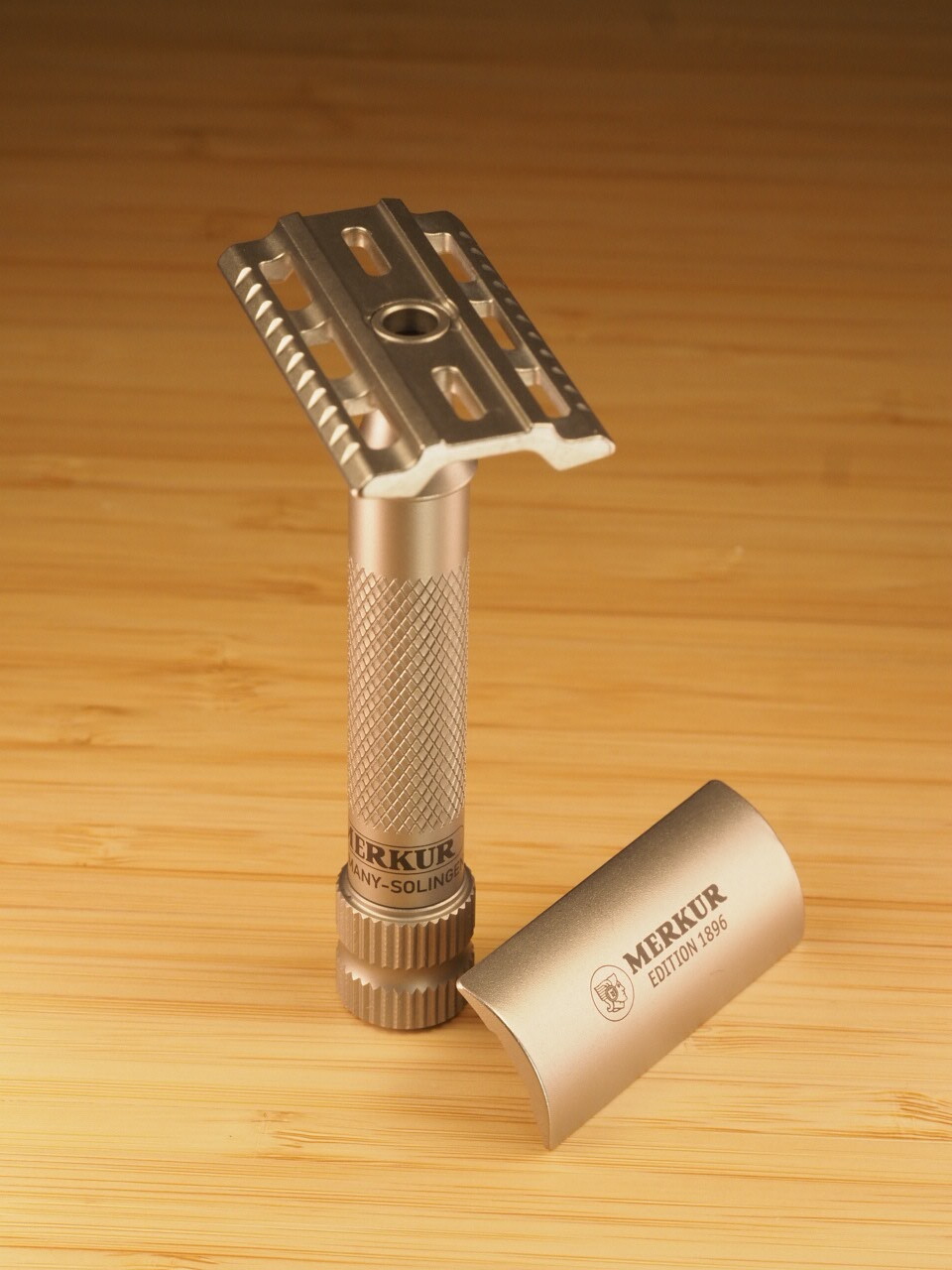
The Merkur 34C Edition 1896 is a two-piece (or three-piece, depending on how you interpret it) DE razor manufactured using MIM. It uses two different steels. The handle is made of AISI 303 and the head (base plate and cap) is made of AISI 316L. AISI 303 is a softer and less corrosion-resistant material than 316L but even so, this razor will outlast us all with only minimal care.

Solingen's shaving industry wasn't (and still isn't) focused on razors but on straight razors. These fine tools were (and still are) the core of the city's manufacturing, with their own protected designation of origin. Therefor, a straight razor must be manufactured, polished and sharpened within the Solingen region to bear the city's name. This quality control is part of the process to maintain Solingen's prestigious reputation.


Solingen received its city charter in 1374 from the Counts of Berg, although the region already had metallurgical activity in medieval times. The will of the Archbishop of Cologne mentions a place called "Solagon" in 965 and in 1067 a chronicler refers to the place as "Solonchon," creating a documented link in the long history of this region.

As is typical, the inhabitants took advantage of what nature offered in their environment to thrive and this region is characterized by mineral deposits, lush forests and fast-flowing rivers that allowed the use of watermills to mechanize the forging, sharpening and tempering of cutting tools. These workshops, located beside the tributaries of the Wupper River, were called "Kotten" and were the catalysts that propelled this region to the forefront of European cutlery.

The city became the cradle of cutlery and knives and today it still produces 90% of all knives in all of Germany. Some well-known brands established in this city are Henckels, Boker, Wüsthof, Puma, Dovo and Merkur and the Solingen label remains a mark of high quality recognized worldwide. This makes Merkur a brand that has to maintain a top-notch reputation and for a long time they did just that with their safety razors, using modest but highly functional designs and humble materials with a reasonable finish to keep prices affordable. This strategy worked very well and Merkur has a wide variety of models that remain benchmarks in the world of shaving despite their age.
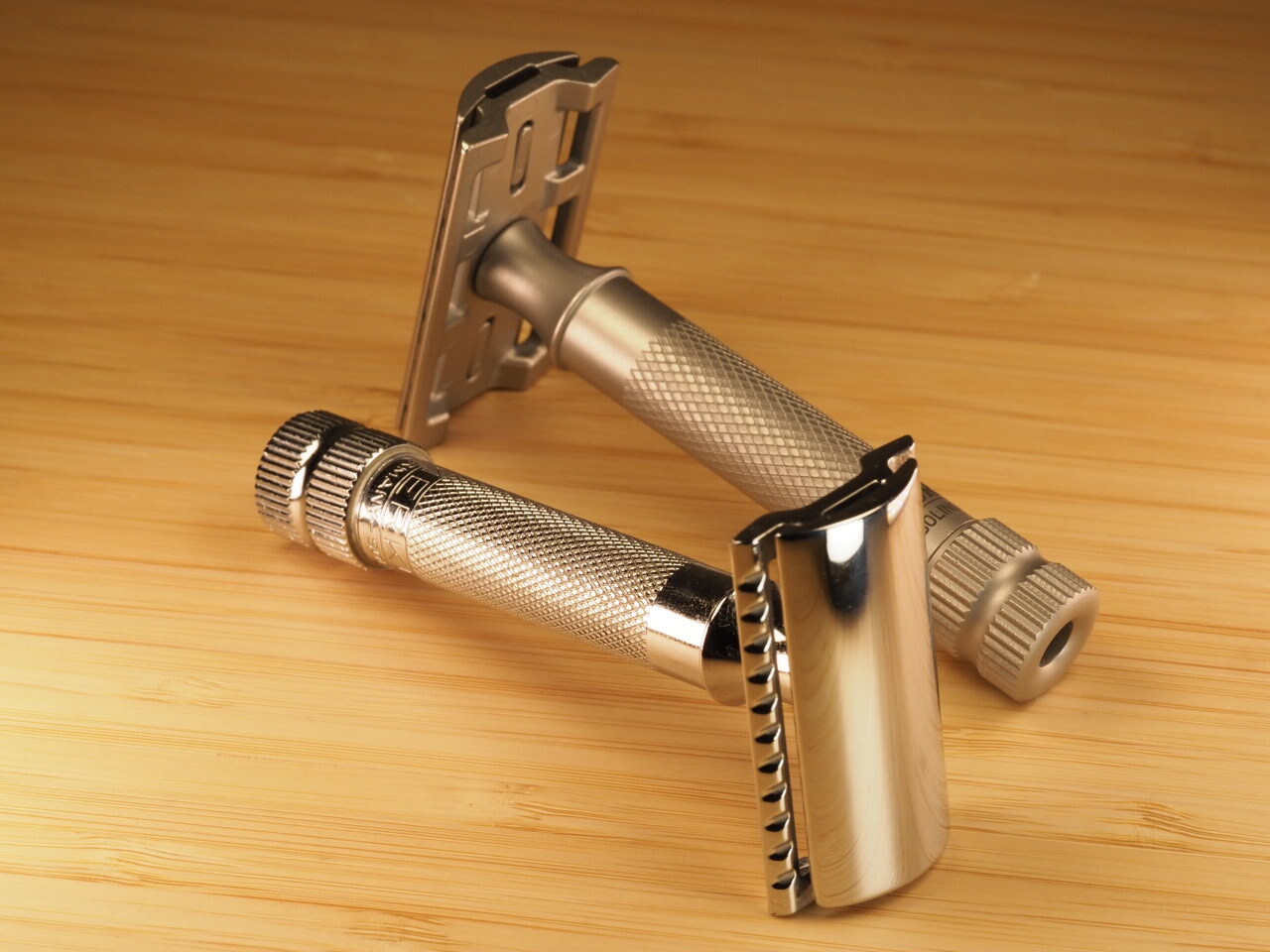
Models based on older designs, such as the 15, 23, 34 and 41, are the most utilitarian and offer cuts that have earned a place in the long history of shaving. But that's not all. The 500 series, the adjustable Progress, is also a shaving icon that Merkur has tried to surpass with its 700 series, the Futur, which looks like a device from a much more advanced era.
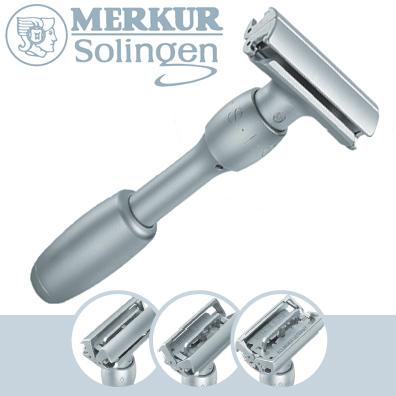
The most advanced for its time was the Merkur Vision 2000, an adjustable butterfly razor made of aluminum, brass and stainless steel. Too "modern" and expensive for its time, it didn't have a long lifespan and is now considered one of Merkur's unicorn razors.
During the early 2010s, classic shaving experienced a resurgence and many manufacturers entered the market. Merkur already had models that had been top sellers for decades and continued with its traditional designs and manufacturing processes, using zinc alloy and chrome plating for its products. But while the competition improved materials, tolerances and production methods, Merkur stuck with its traditional products.

This changed because they recently introduced an alternative line in their catalog where they use stainless steel to recreate some of their most iconic models, such as the 23 and 34. Using the MIM (Metal Injection Molding) technique, they manufacture these models in different types of steel. MIM is a technique that combines plastic injection molding with a mixture of steel powder to create parts in molds with greater precision than with cast material (such as zinc alloy) but with less precision (and lower cost) than CNC machining. Other famous razors manufactured using MIM are the Rockwell 6S and the Mühle Rocca, two razors that have performed quite well.
Material: 316L stainless steel (lid and base plate), 303 (handle)
Finish: Matte Gray
Handle length: 76 mm
Handle diameter: 11.6 mm (Knob: 14 mm)
Total length of the razor: 83 mm
Total weight: 77 gr
Cap weight: 15.6 gr
Cap height: 4.7 mm
Lid width: 19.39 mm
Gap: 0,71 mm
Exposure: neutral
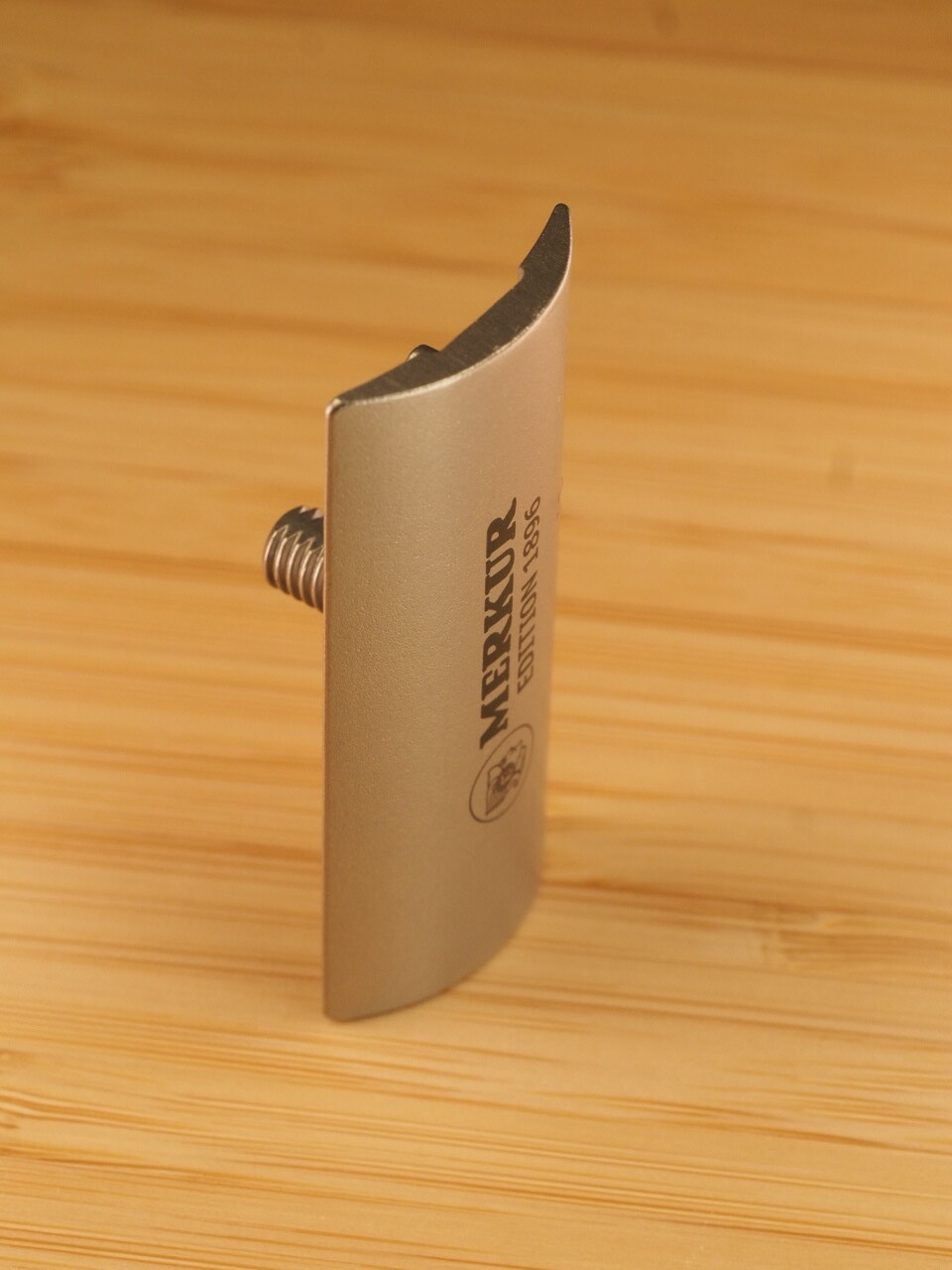
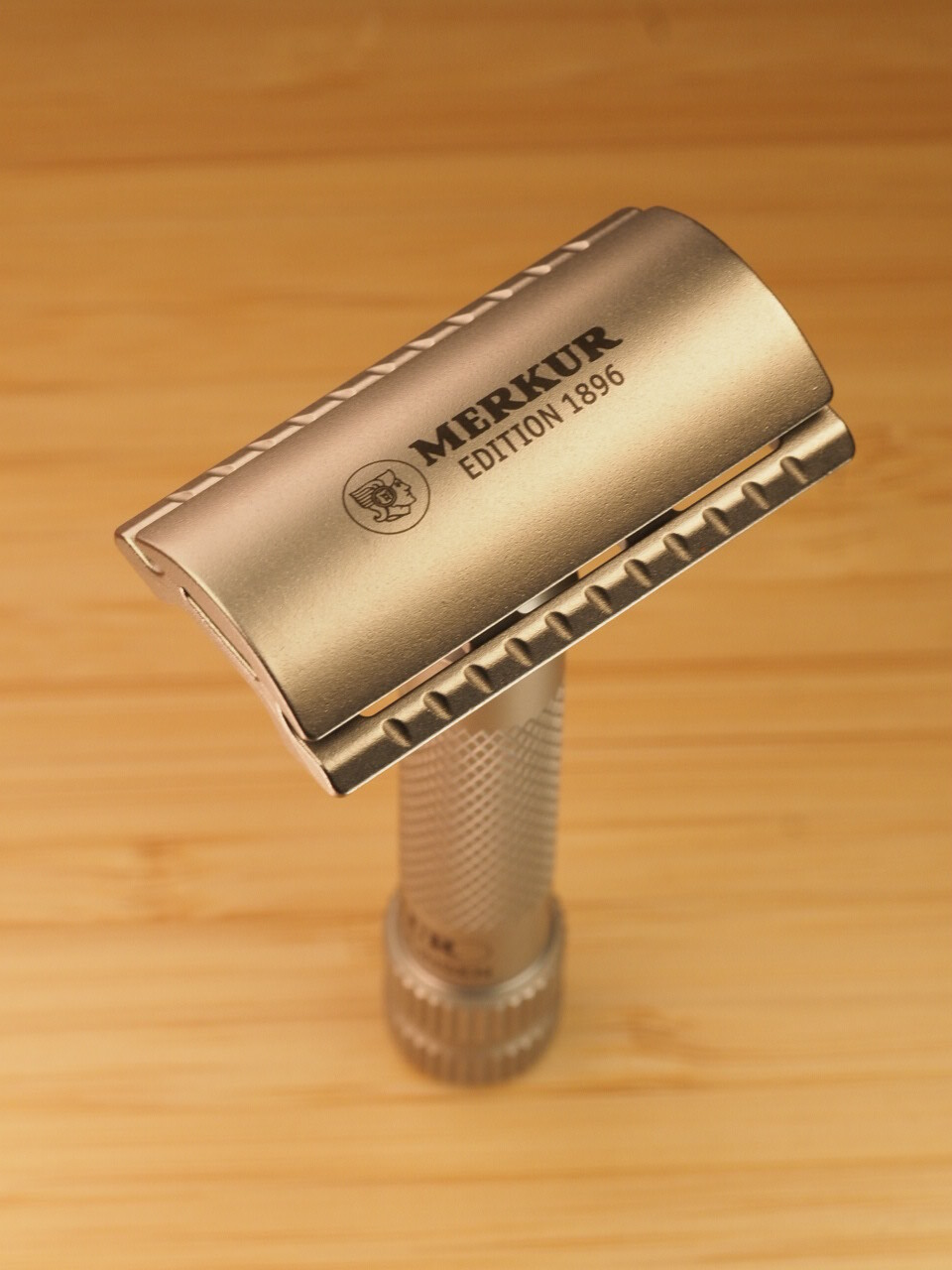
Focusing on the 34C stainless steel model we have here today, we can see a very recognizable top section of the cap, as it has the same curve as its chrome counterpart. In the center of the cap, we see the logo and brand name, along with "Edition 1896," giving this special edition its distinctive touch. A nice detail.
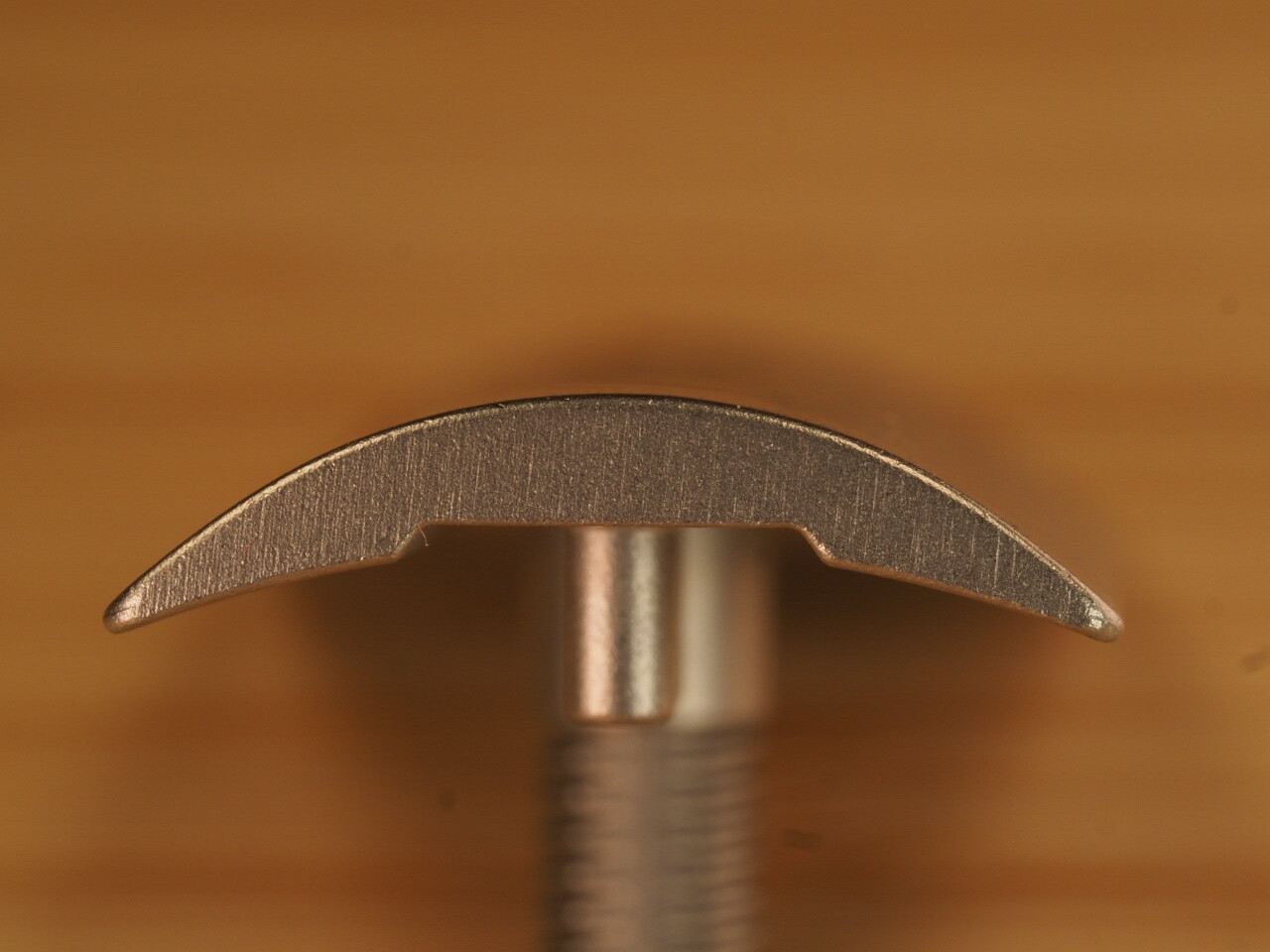
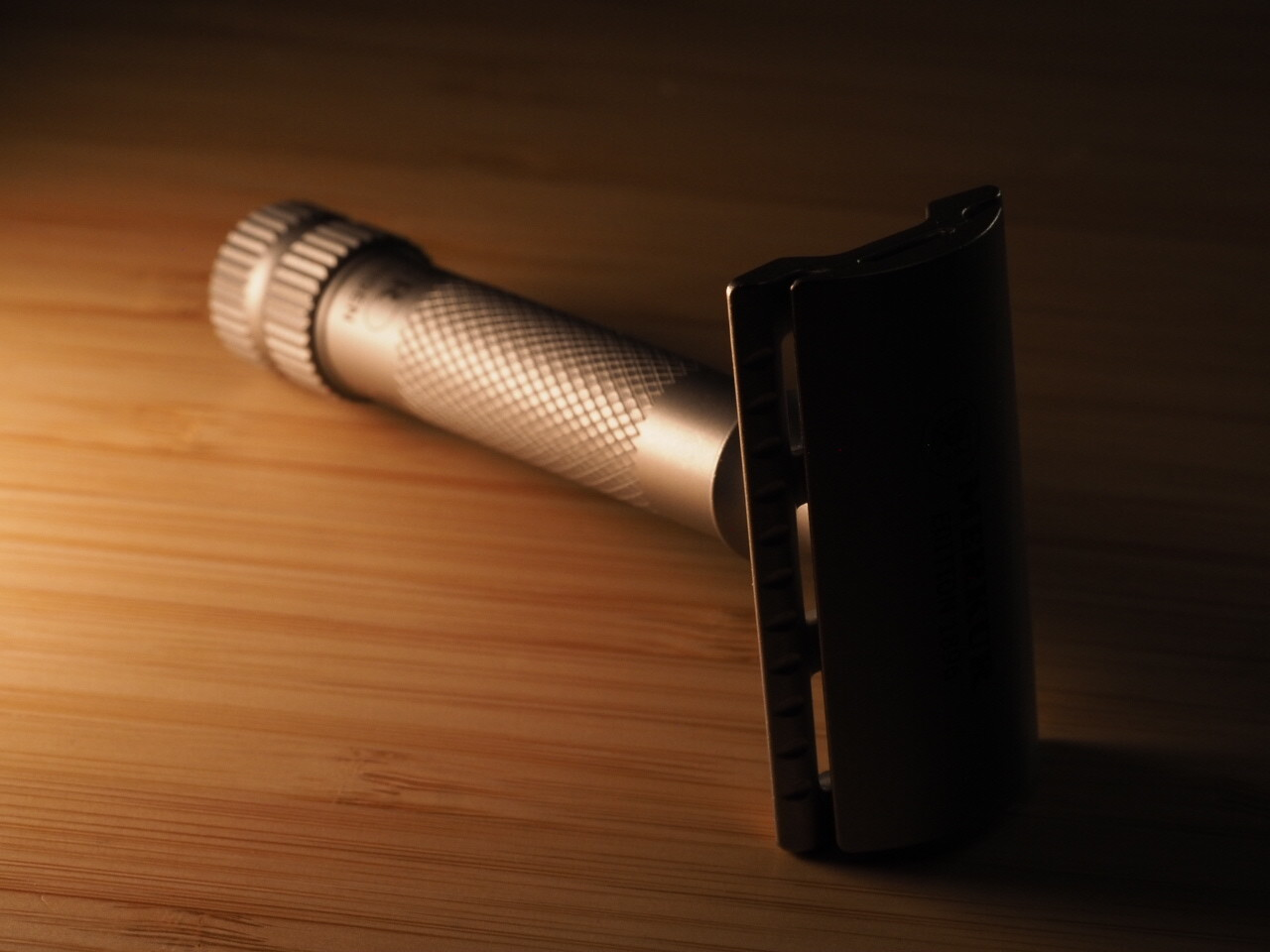
In profile, we see the silhouette of almost all the caps that follow this design. A fairly pronounced curve, a somewhat thick cap and two mounting surfaces that create a relatively gentle cutting angle. Many Type 34 and R89 razors use this cap profile and provide smooth shaves with a moderate amount of efficiency.
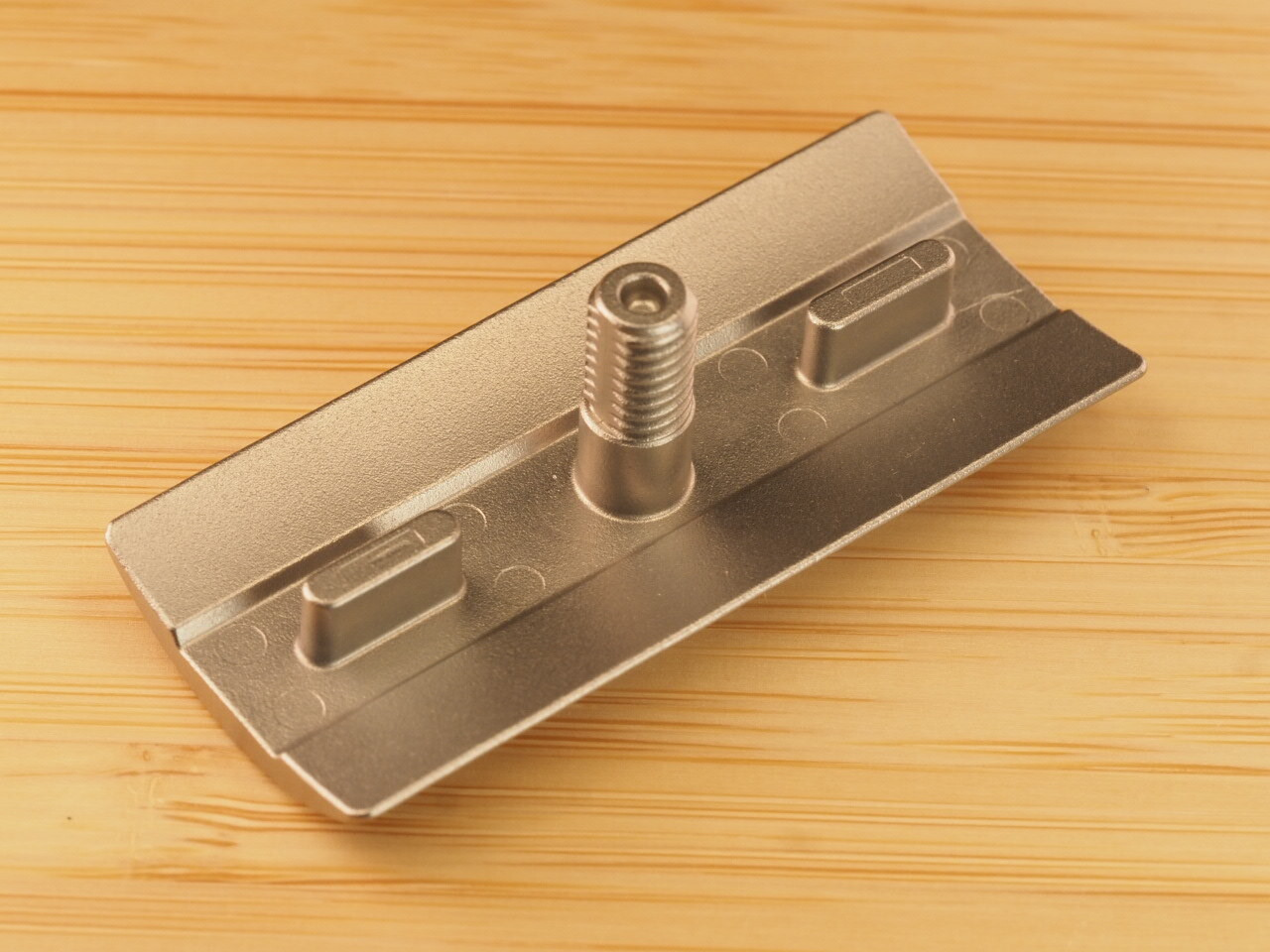
Inside the cap, we see two major differences compared to the Zamak version. The central thread on the steel version is much shorter and it uses longitudinal guides instead of cylindrical ones. These guides provide a more precise positioning of the blade.
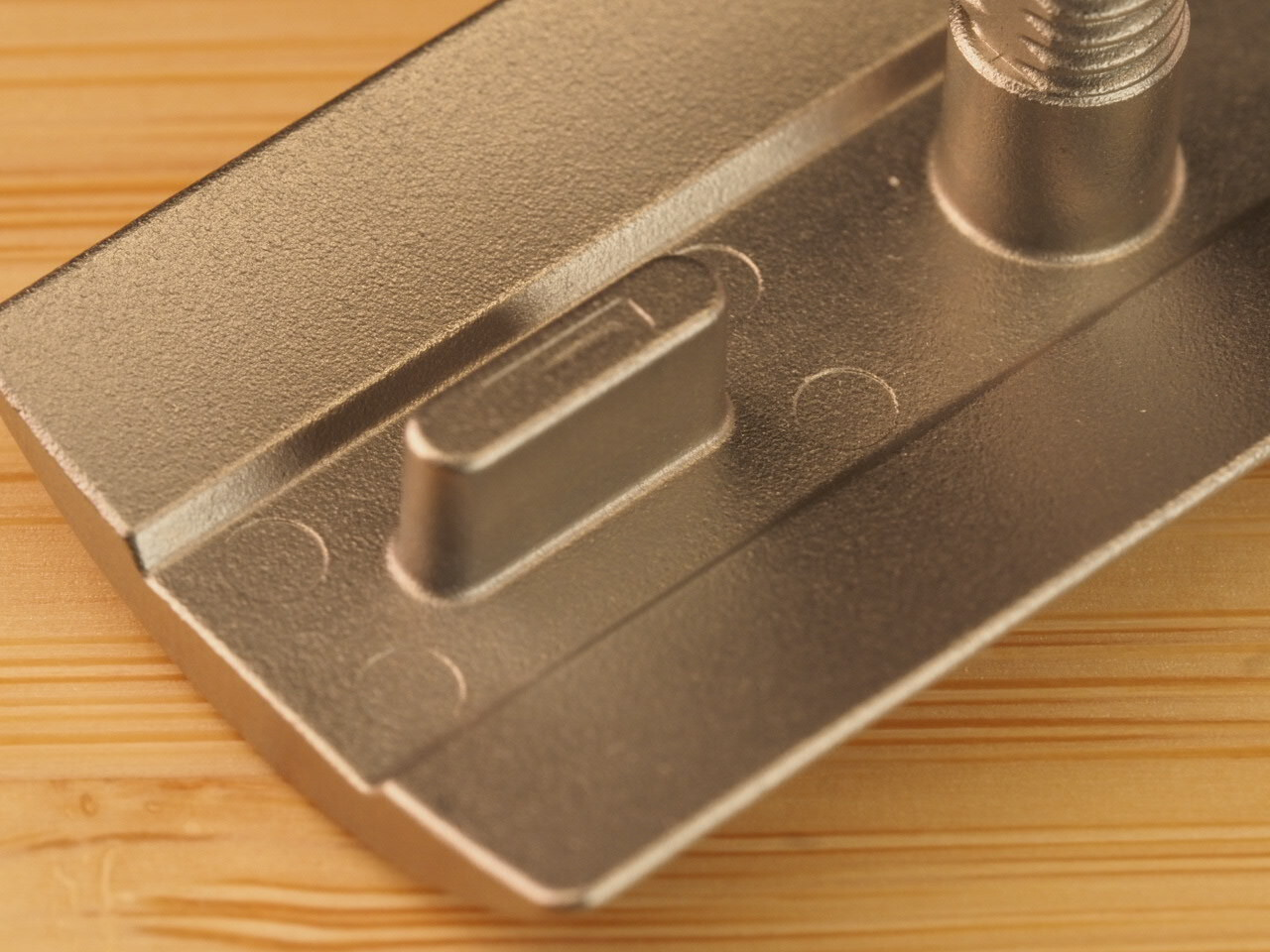
Inside the cap, we also see two elements that clearly indicate this part was created using MIM (Metal Injection Molding). First, we see the injection channels in the center of the cap. The combined paste of steel powder and carrier agents, which are largely removed during the process, is introduced through these channels.

We also see that the thread has two flat parts, one on each side. This also indicates that MIM was used. The paste is injected into a mold made of two parts that fit together. Once the piece is molded, the parts separate and the piece is removed. There are always marks visible at the seam where the two mold parts meet because there's always some space where the paste can be inserted. This is often seen in plastic parts and these burrs are easily removed. However, a thread has cavities and at the seam, the material would be forced into the threads, creating an obstruction within them. Therefore, flat surfaces are used where the mold pieces join, so that any potential marks don't interfere with the threading process and can be easily polished.

Looking at the profile of the base plate, we can clearly see the line which forms where the two parts of the mold meet. In this case, the mold has a top and bottom section that follows the side line of the plate. On this surface, the seam line does not interfere with the proper functioning of the razor and can be easily polished.

And the base plate reveals another significant difference compared to its Zamak counterpart. Not only does the cap screw on but the base plate itself also screws on. In the original, the handle is press-fitted into the base plate. When manufacturing the base plate for this stainless steel version, the central hole is likely unthreaded. It's produced with smooth walls. After the plate is fabricated, a central thread is cut into it to allow mounting on the handle, which is lathe-machined from a softer steel than the cap and plate.

On the inside of the base plate, we see the central body with the central thread for the handle and the openings for the longitudinal guides. These openings are considerably larger than the guides on the cap. We can see some manufacturing marks where the paste didn't fill all the gaps or where the transfer agents were removed. Two mounting rails complete the central body.
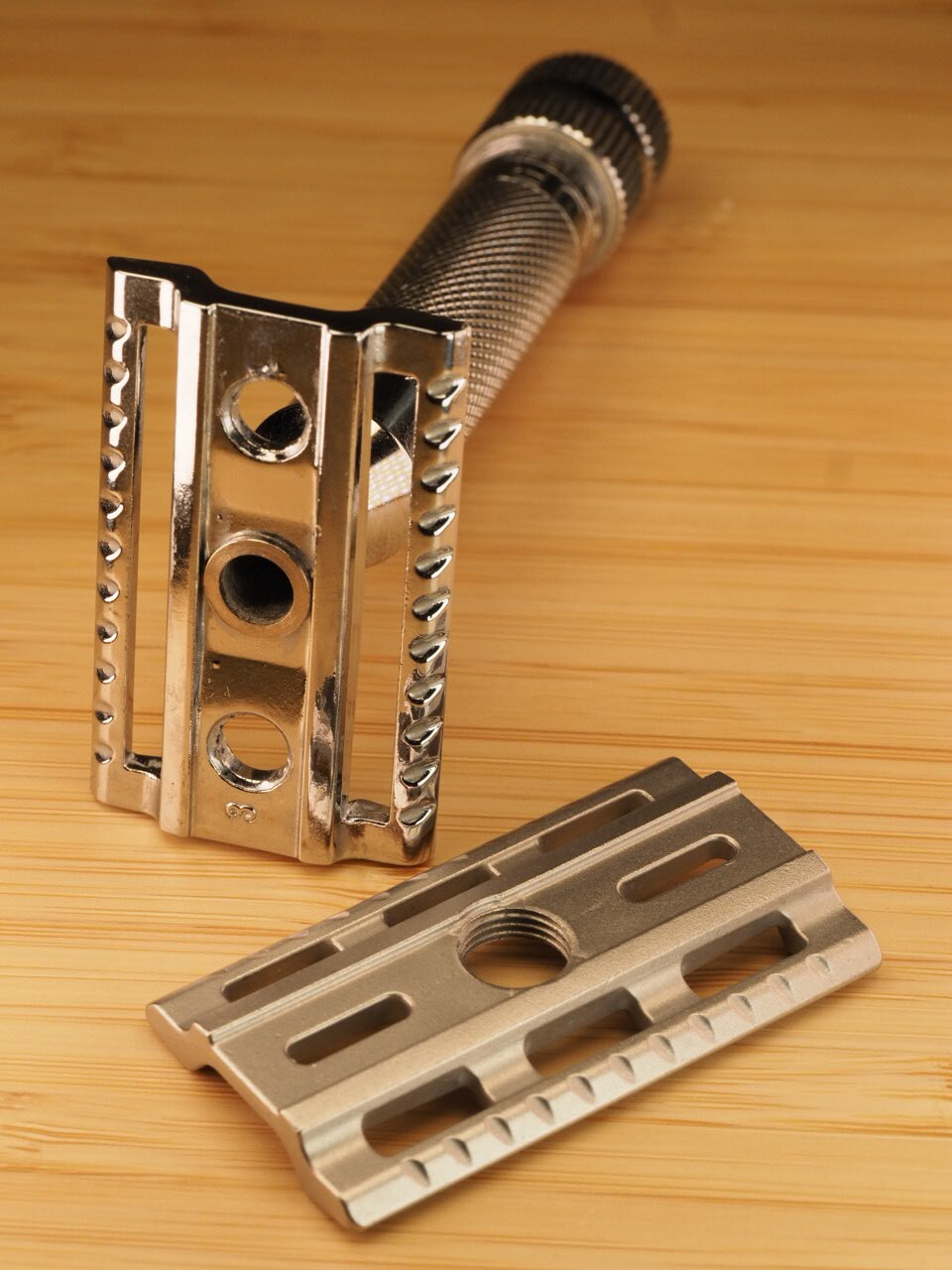
Along the long sides of the central body, we see the combs, which have four supports that create three rinsing channels. The original razor only has two supports, creating one wide, continuous channel.

On the underside of the plate, we see everything we also saw inside. The holes clearly show that the tolerances are quite generous when everything is assembled. We also see the circular mold entry and exit points. By placing these entry points on the underside of the plate, they are largely hidden from view. A good choice. They could have been hidden even more if the entry and exit points had been placed on the inside of the base plate but that could have affected the tolerances of the mounting rails. Being the highest part of the plate, some of the entry and exit points should have been positioned directly on the rails, thus leaving those circular marks right where the blade is clamped. They chose not to take that risk and I think they made the right decision. The finish and tolerances are better than the Zamak version but not by much. MIM machining has its limitations and isn't as precise as CNC machining. Even so, all the shapes of the Zamak version are more defined in the steel version. It undoubtedly looks the part.

The finish is that typical gray that looks like it's been bead blasted but it's simply the steel left like that after the solvents that turn steel powder into a moldable paste, are removed. It's a very good finish that's functional and clean. It can be polished but these gray, slightly rough finishes always look good, not only aesthetically but also functionally.

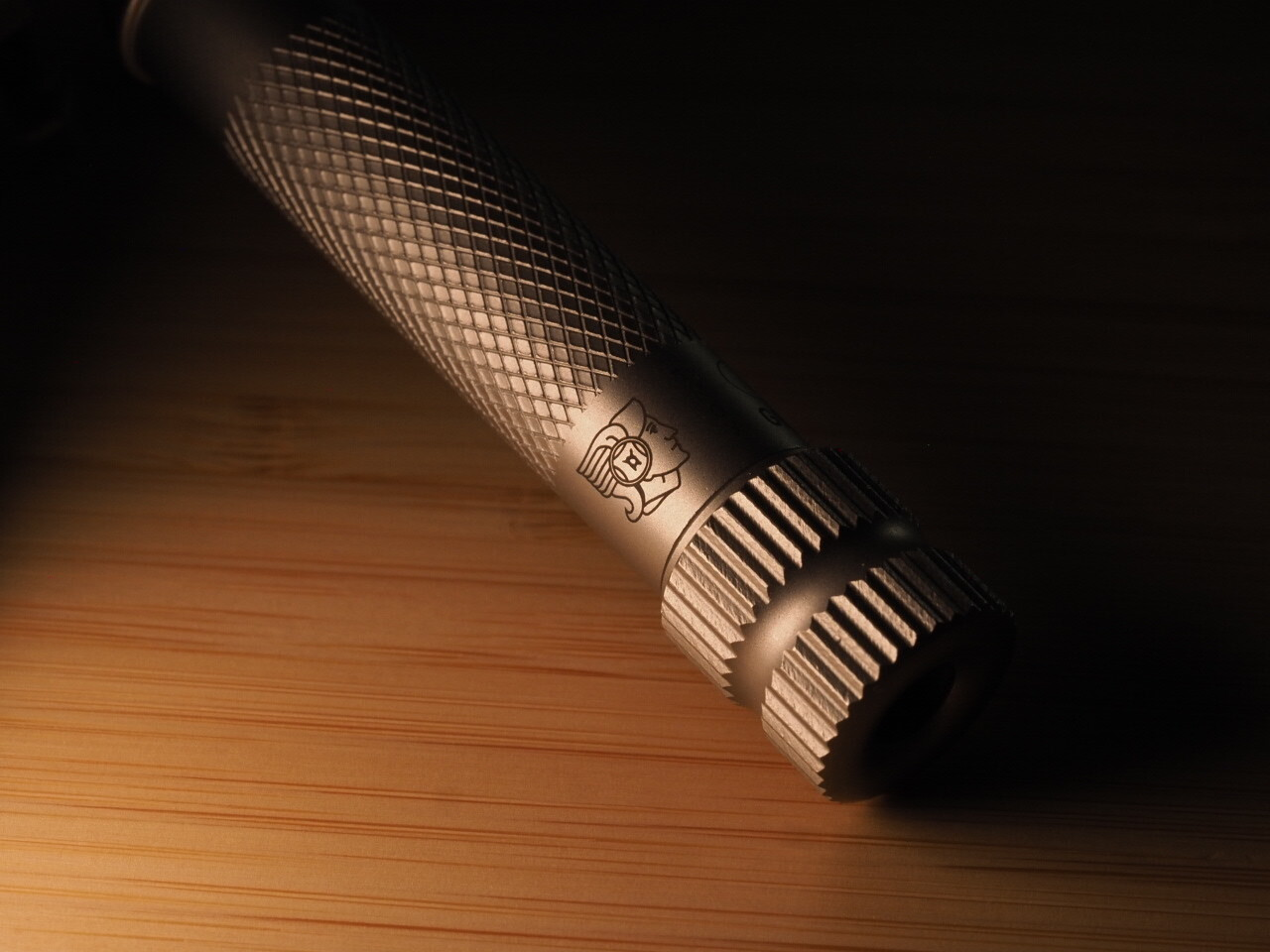
The razor's name is printed on the cap and at the base of the handle, just above the knob used to (un)screw the cap. The handle displays the logo and brand name, the material and the protected designation of origin from Solingen, Germany. These details are very attractive and make it stand out.
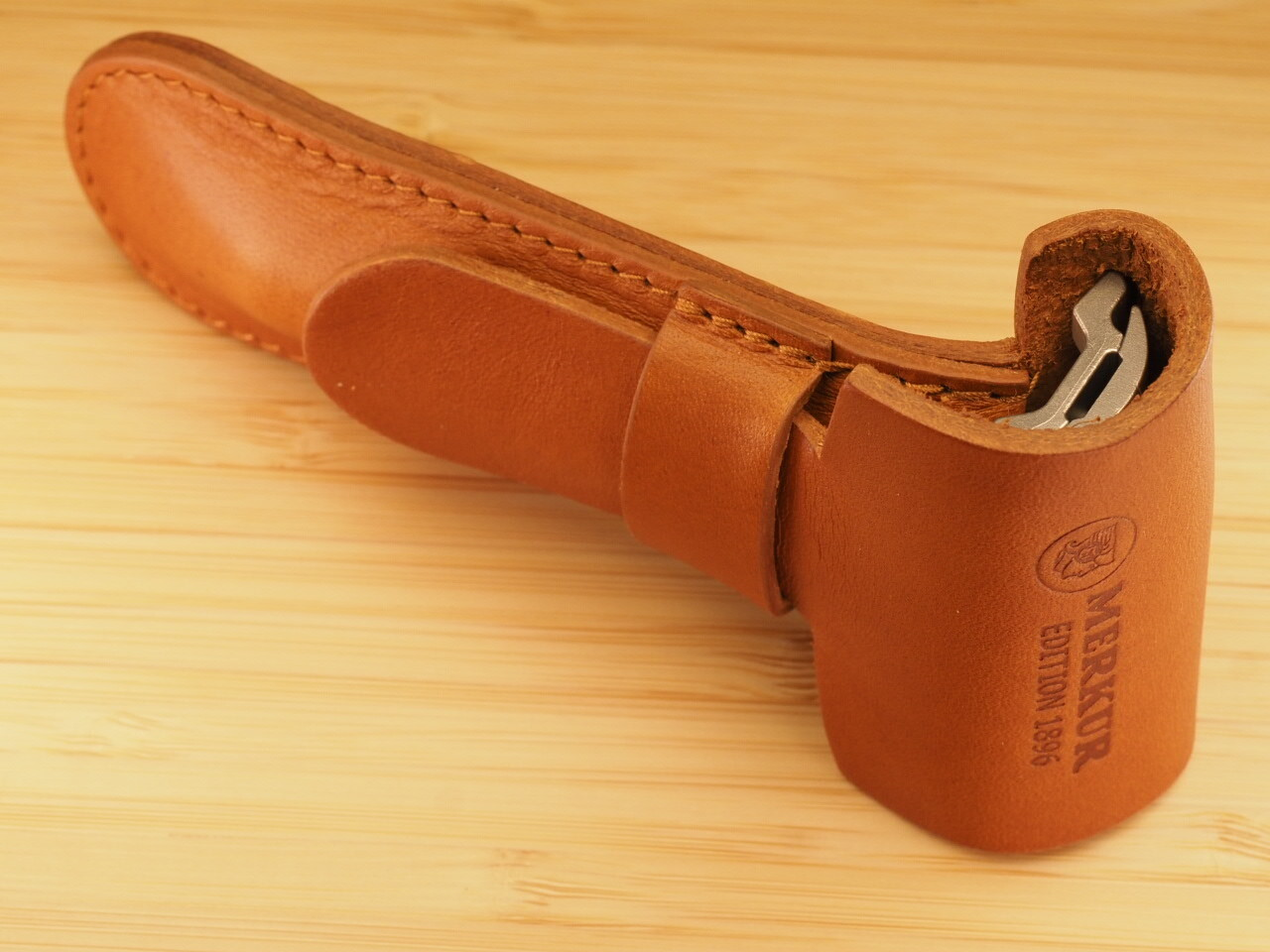
The set also comes with a leather case, engraved with the name and special edition. Another nice and practical detail that allows you to take the razor with you when traveling without fear of damaging it.
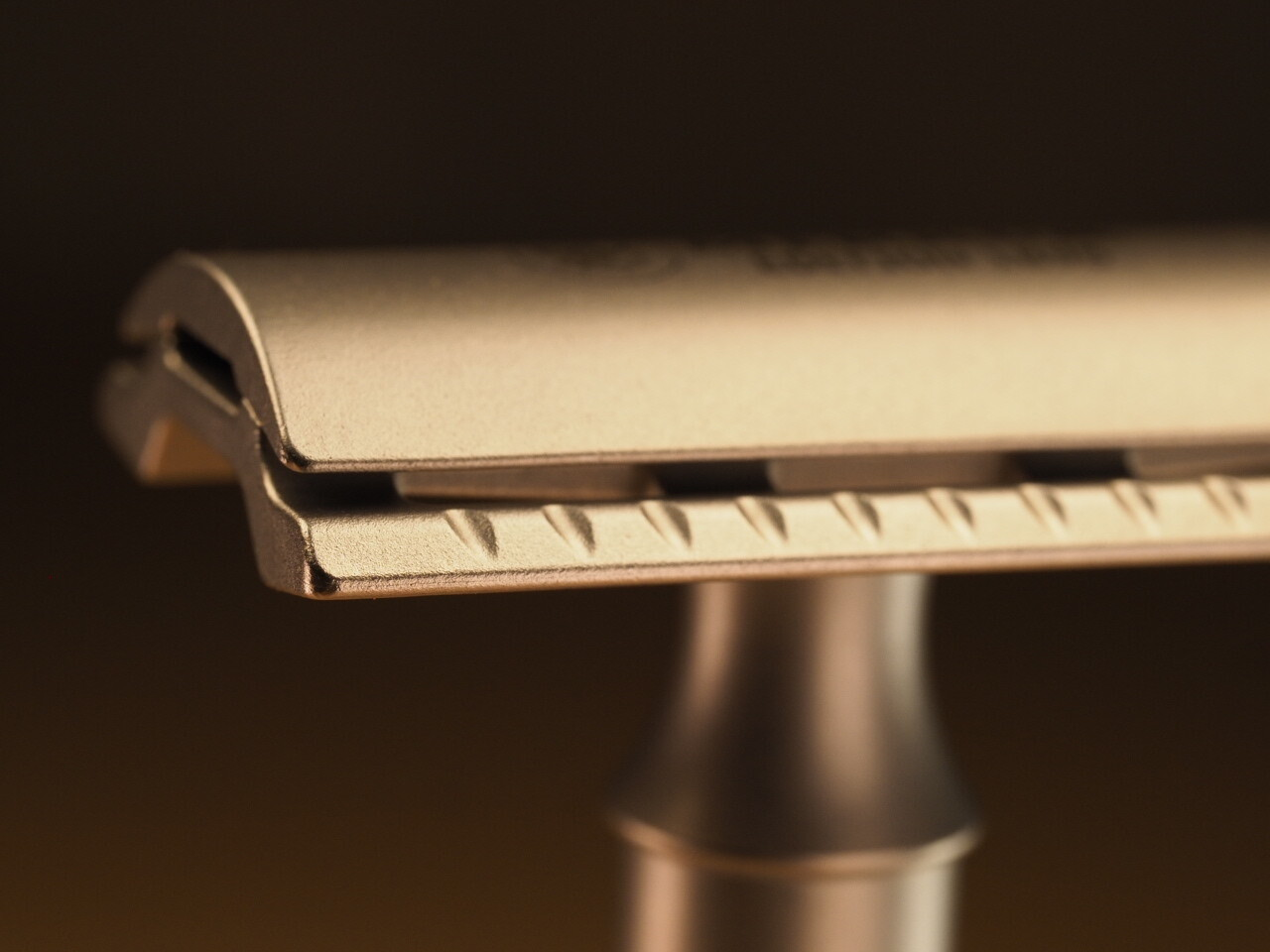
The comb is slightly different from the original version. The front surface, where the grooves are located and which forms part of the shaving surface, is more defined than in the original version. It's somewhat wider, has more defined grooves and is slightly thicker overall without changing the gap. It's a very comfortable and functional head. Being German, we could call it the Volkswagen Golf of shaving. Very recognizable and super easy to use.
Score: 16 points
Material/Construction: 4
Finish: 4
Tolerances: 4
Head/comb shape: 4
Grip
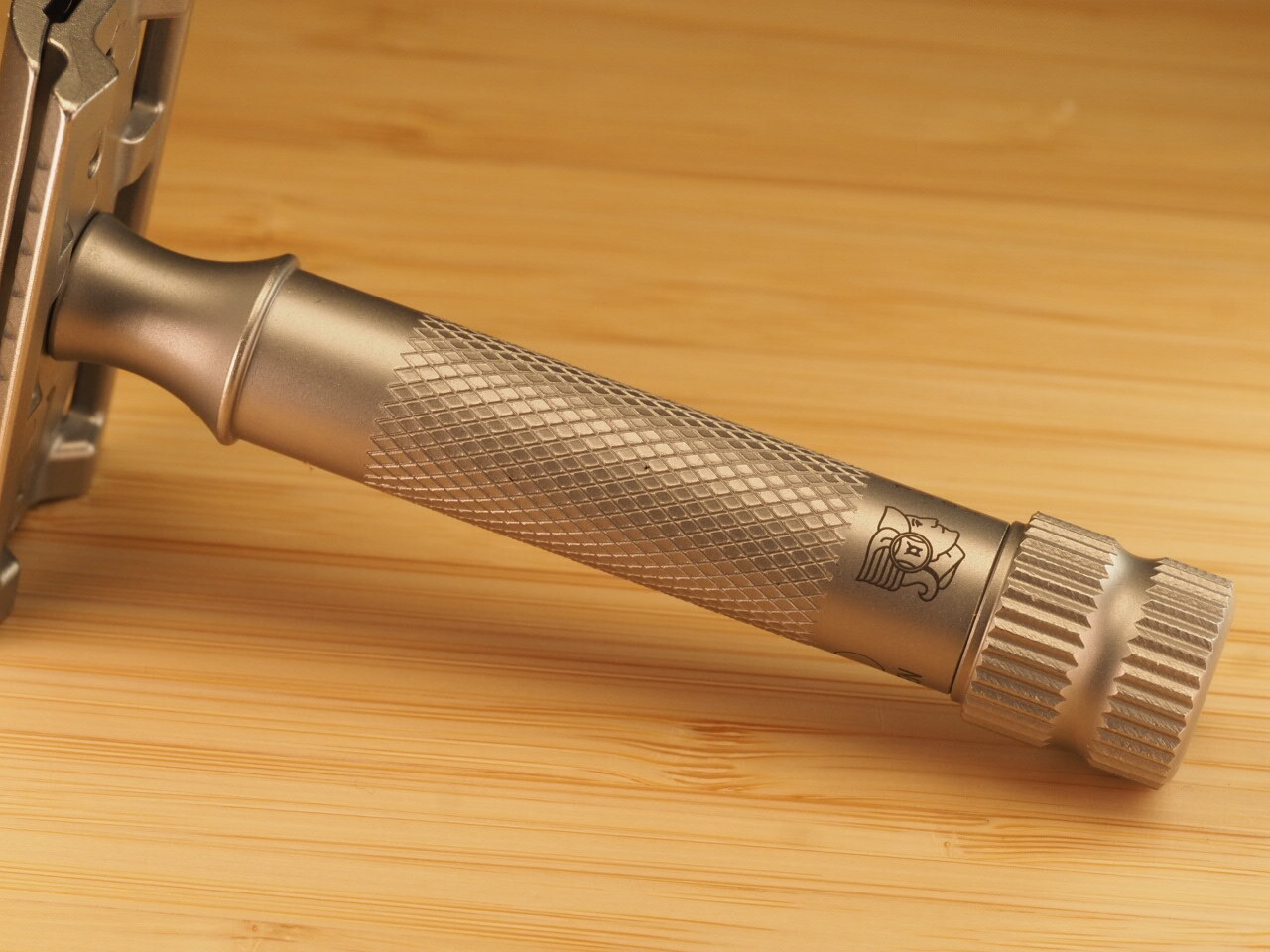
The grip is also a slight improvement over its predecessor. The material offers greater friction than the chrome plating of the original. And because it lacks a chrome coating, the central knurling and the fillets on the knob are (much) more defined. In short, it improves upon all the elements of the original except for the length. The handle remains one of the shortest on the market and only allows for a two-finger grip.
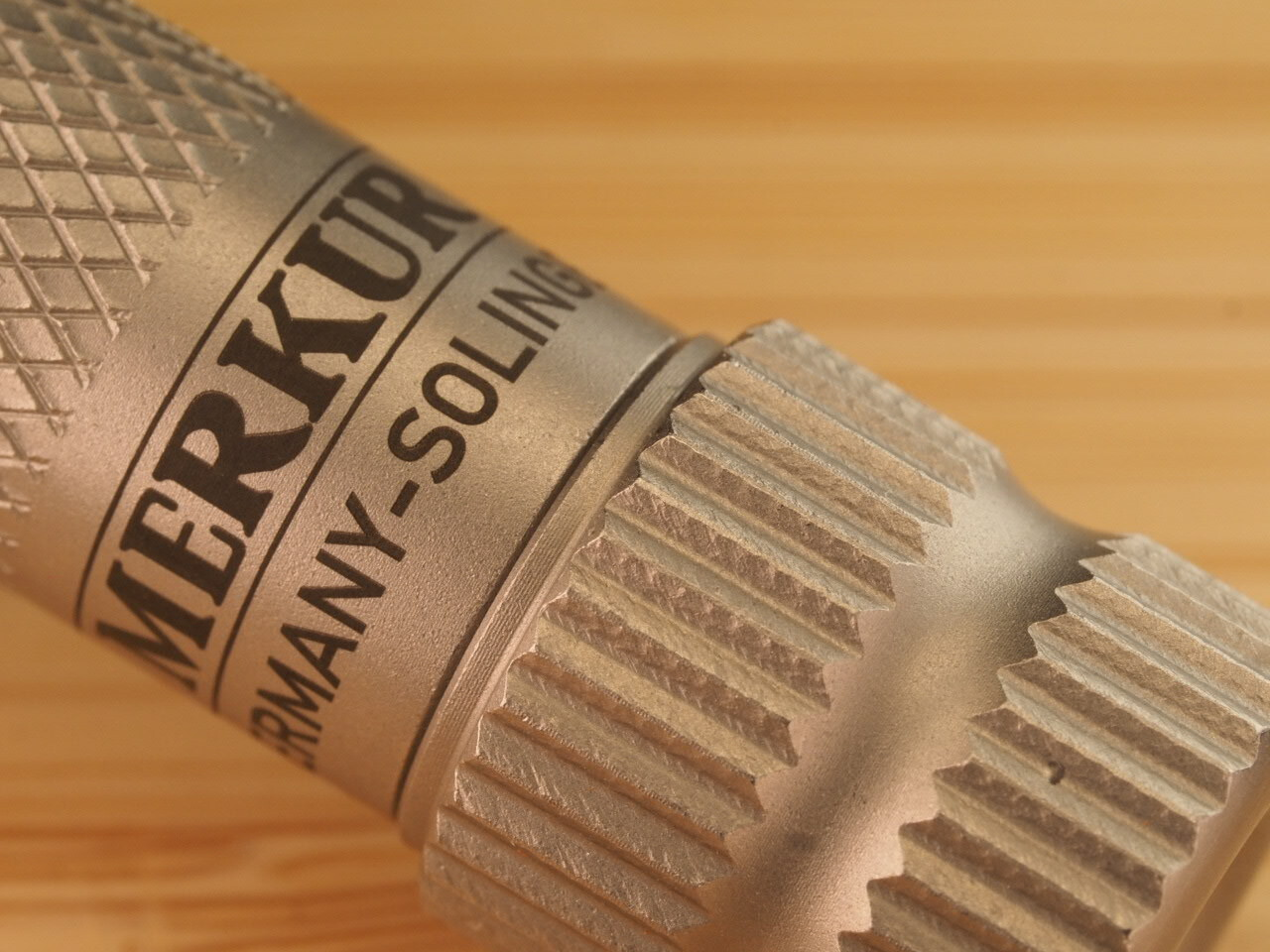
The material has a pleasant feel and is comfortable. The only part that's slightly more noticeable is the top of the knob's grooves. They offer more grip due to their greater definition but they also have sharper corners. This reduces comfort somewhat. Every advantage has its disadvantage.
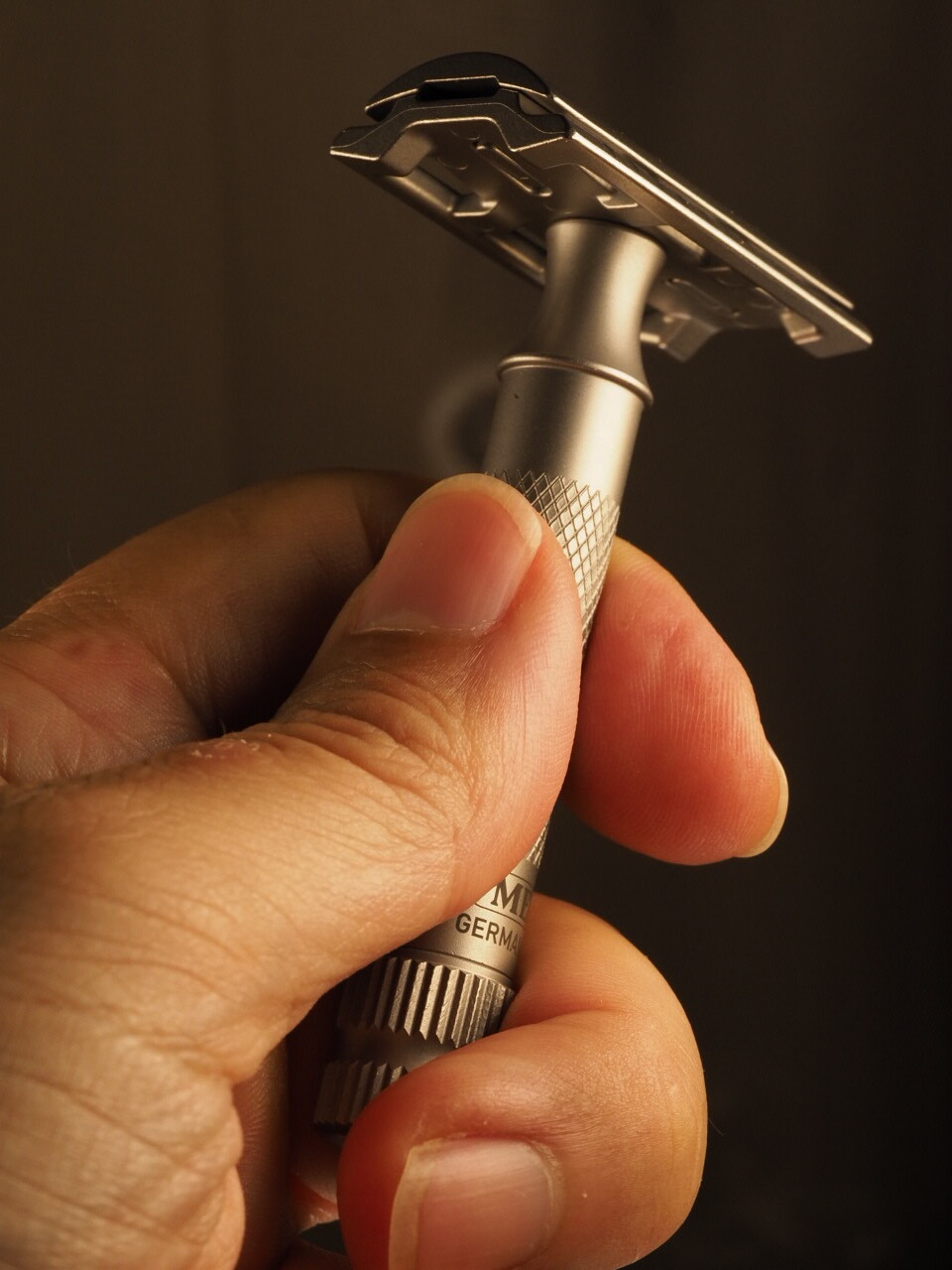
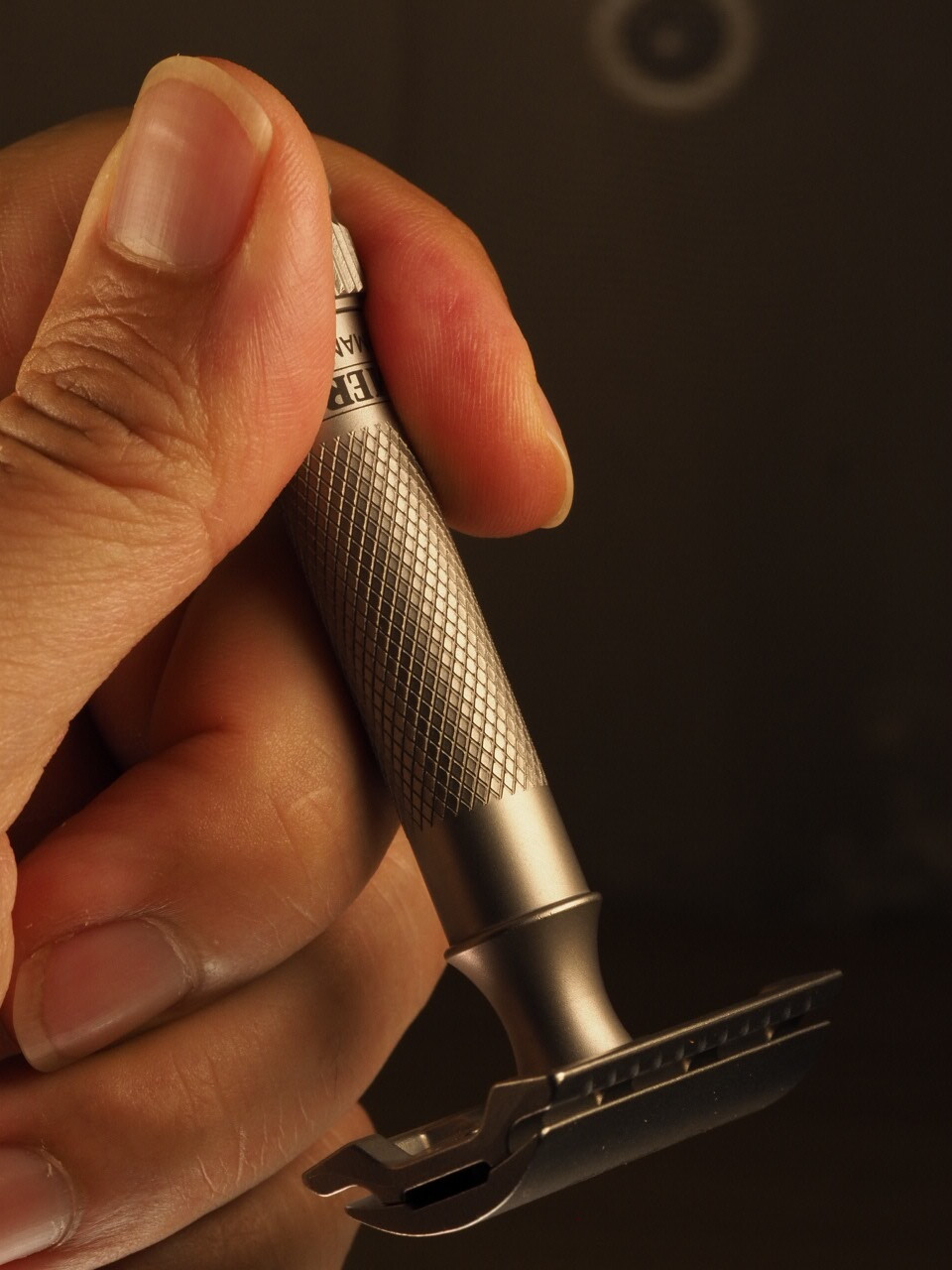

The control isn't bad because the knob helps a lot in finding grips that work but the razor is short and that always needs to be taken into account. You can distance your fingers further from the head for better visibility and reducing the times your fingers are covered in shaving residue but everything revolves around the knob. The razor isn't very light for its compact shape either, which forces you to find grips that don't compromise its use. When there’s more weight to move around but less grip, you need to make due with what you have available.
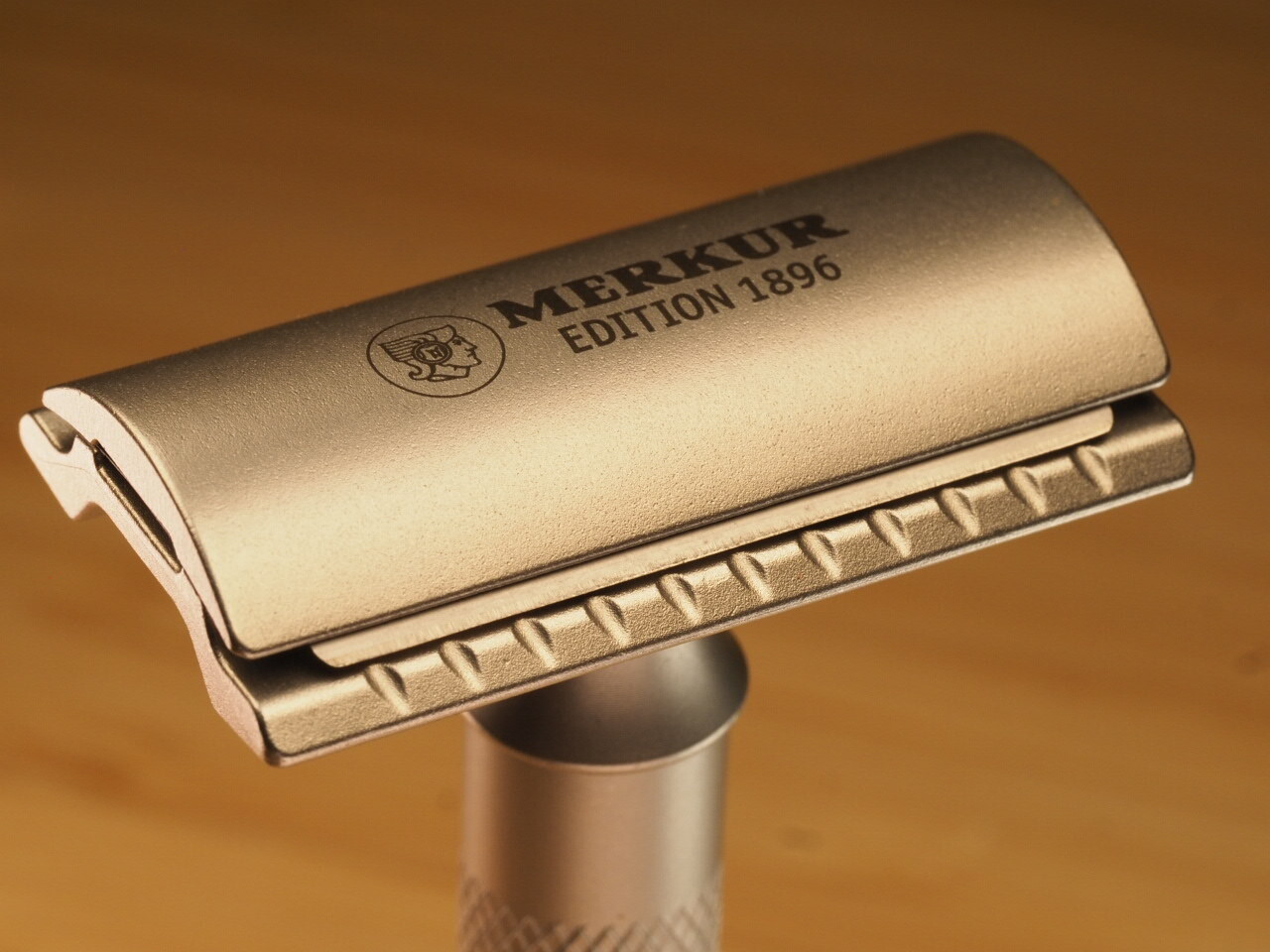
The glide is good. The shaving surface is very easy to find and the weight helps the razor glide smoothly. The surface is somewhat rough and with soaps that have slightly less lubrication, you can feel it stretching the skin more as it passes over it. It's not bothersome because stretching the skin also helps with the cut, especially with less efficient razors like this one but you do notice a bit more friction. The grooves allow some lubrication to pass through but they aren't very deep.
Score: 15 points
Dry/Wet: 4
Comfort: 4
Control: 3
Head slide: 4
Handling
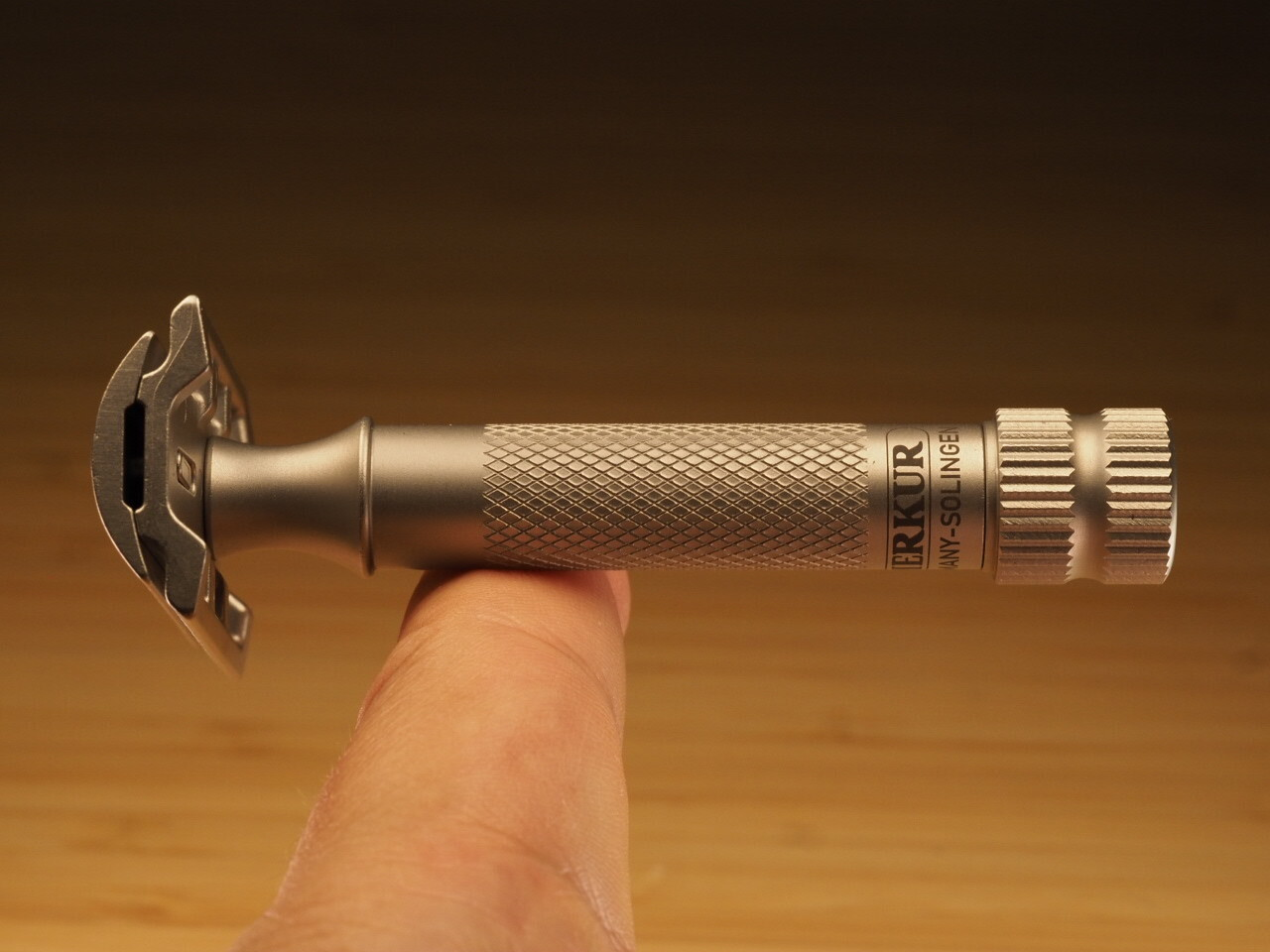
Being such a short razor, with a hollow handle due to the threading that has to reach from the knob to that very short thread on the cap (yes, we'll talk more about that devilish threading later…) and a head that doesn't skimp on materials, the balance point is located in a perfectly logical spot but very close to the head. As I said before, this shouldn't be a problem if you like the smell of shaving cream in the morning on your fingers or if you're happy with an alternative grip. The weight is also no surprise. It's nearly 80 grams of steel in a tiny body. It feels solid and compact, conveying an industrial feel, just like its sister razor. This razor feels more like an industrial tool than a surgical instrument. Both have their place in this world and the Merkur Edition 1896 never hides what it wants to be.
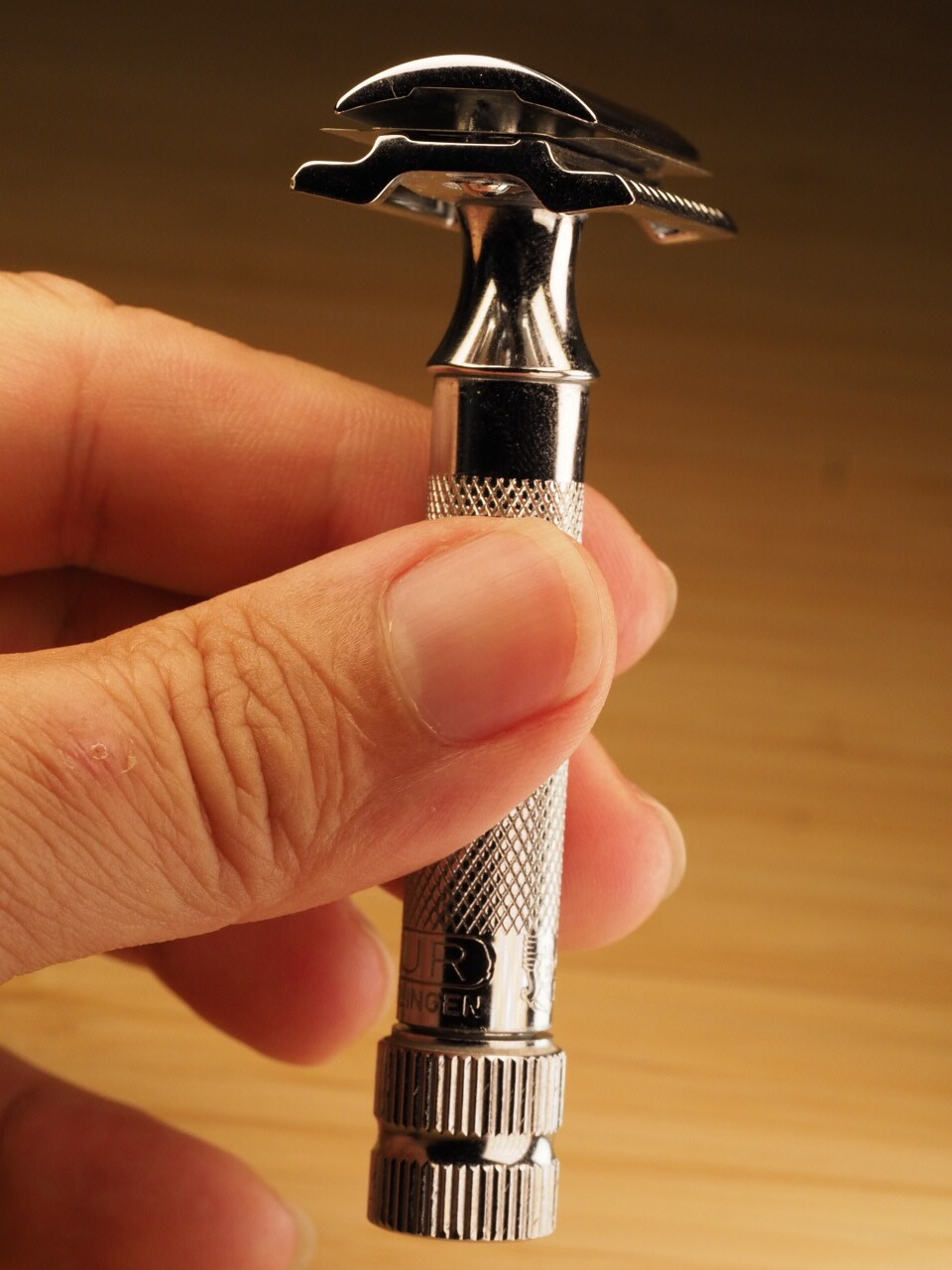
What did disappoint me quite a bit was the short thread on the cap. One of the great advantages of two-piece razors is how safe they are when you assemble them. You place the blade in the cap, put the cap and blade assembly onto the base plate and move your fingers away from the blade to tighten the thread with the knob. Super safe and convenient.
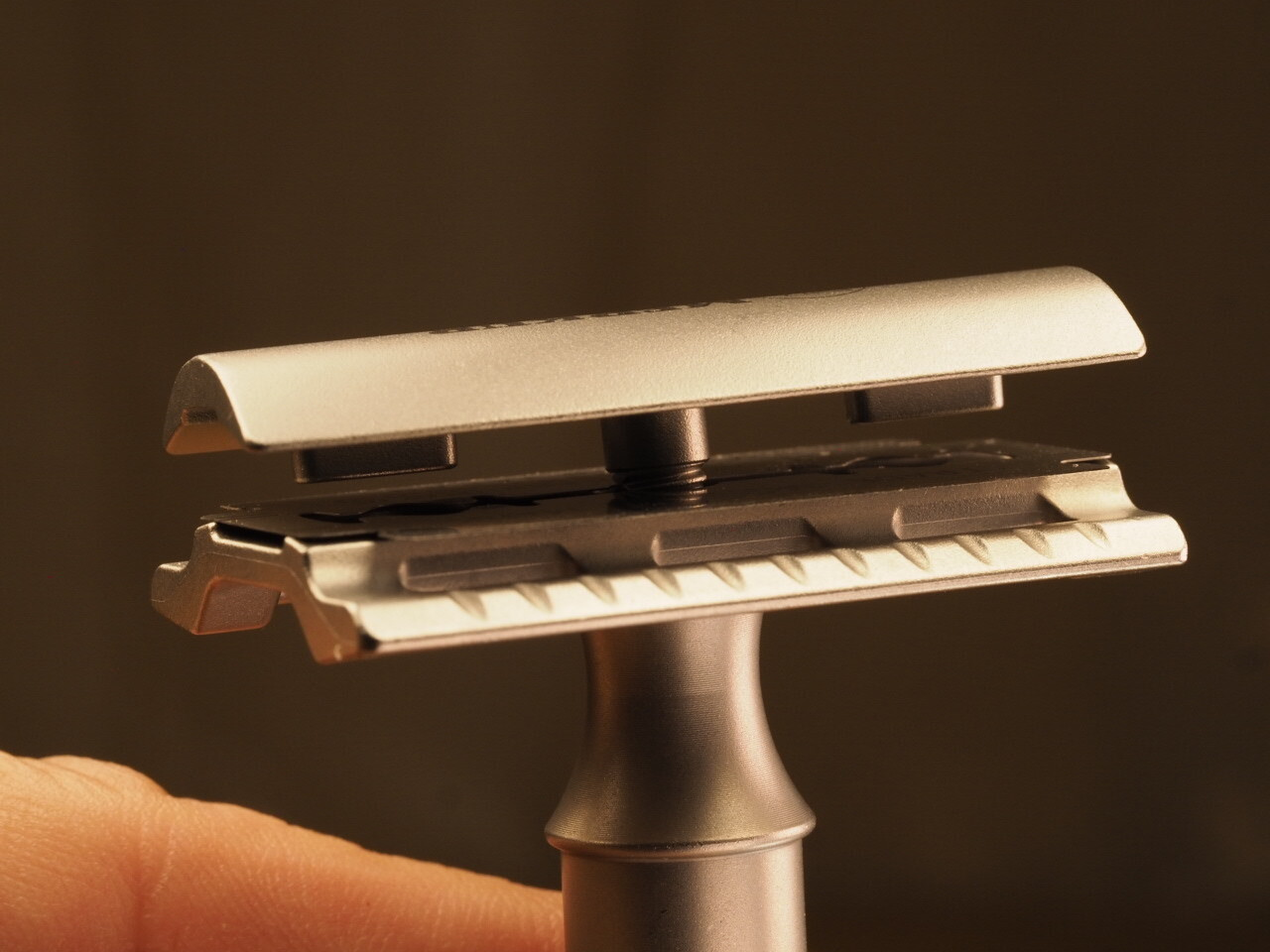
If you use the same procedure with this Merkur 34 1896, you'll be in for an unpleasant surprise. The guides aren't high enough to reach the base plate and the internal thread is either too long or the cap's thread is too short. This means that when you place the cap with the blade on top of the base plate, everything is precariously balanced on the central thread.

And if you start turning the knob to tighten the screw, the whole cap with the blade starts turning too! There's no other option but to grip the sides of the cap and the blade with your fingers and tighten the screw with the knob, which, with this design, is anything but a comfortable operation. I'd say it's considerably more awkward than assembling a conventional three-piece razor. It turns its greatest advantage in its greatest disadvantage.
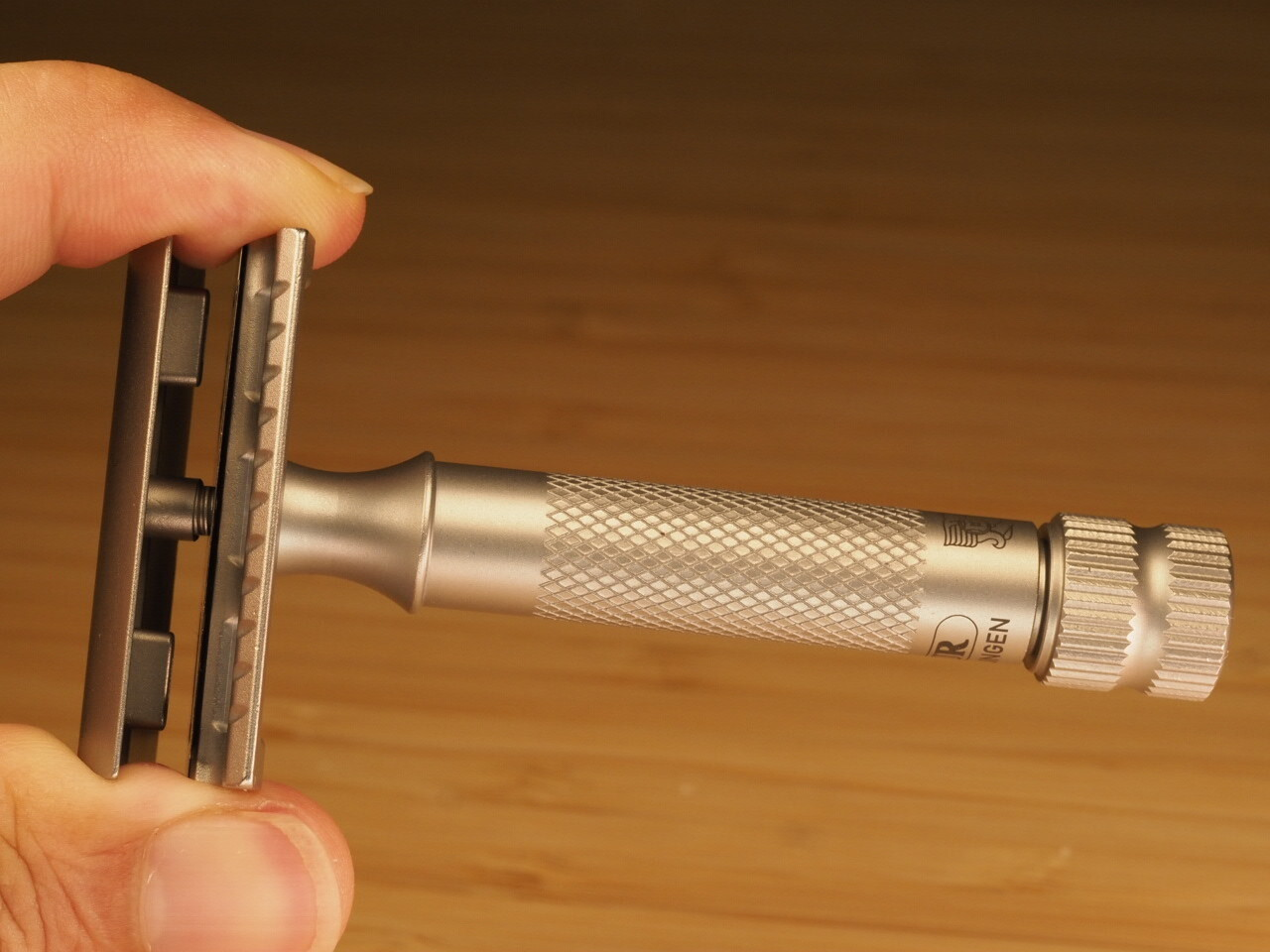
The reason is the large gap between the cap and the plate when you assemble everything, forcing you to support the entire weight of the razor with two fingers on the short sides of the head while turning the screw with the knob. For me, it's clearly a missed opportunity. The central thread should have been slightly longer so that the internal thread could have been shorter, allowing the cap to be positioned closer to the plate so the guides would align with their holes. This would have prevented the cap from shifting while screwing it on.
Cleaning is also somewhat hampered by the handle's design. The cap presents some obstacles, as does the comb but it's the inside of the handle where limescale and residue tend to accumulate. It's likely possible to disassemble it but it doesn't seem very easy to do. The comb also presents more obstacles than the original version due to its additional supports. The surface, however, is easy to clean as it doesn't attract fingerprints.
Score: 12
Balance: 3
Weight: 3
Model: 3
Cleaning: 3
Shaving

The original Merkur 34C shaves well but it's not a super-efficient razor. It's a razor that performs very well once you get the hang of it. And with this Edition 1896, the story is the same. The geometry is the same but I prefer the shave this steel version offers to the original Zamak one.

And I think the reason lies in the slightly improved design of the comb, which creates a super comfortable and very easy-to-maintain shaving plane. More than anything, this razor offers a very comfortable and relaxed shave. It's not the closest shaver; in that respect, it's similar to its better-known rival, the R89 but that's not necessarily a bad thing.
The head isn't too bulky but it's not the smallest either. You can easily reach all areas. The problem arises when you have to change your grip and "force" the cut a bit because of its inherent softness. To shave well in areas where the hairs are somewhat hidden, you have to press harder and that can cause other problems. The same is true if the handle isn't long enough to properly position the head and/or apply that pressure. A shorter handle means less leverage.
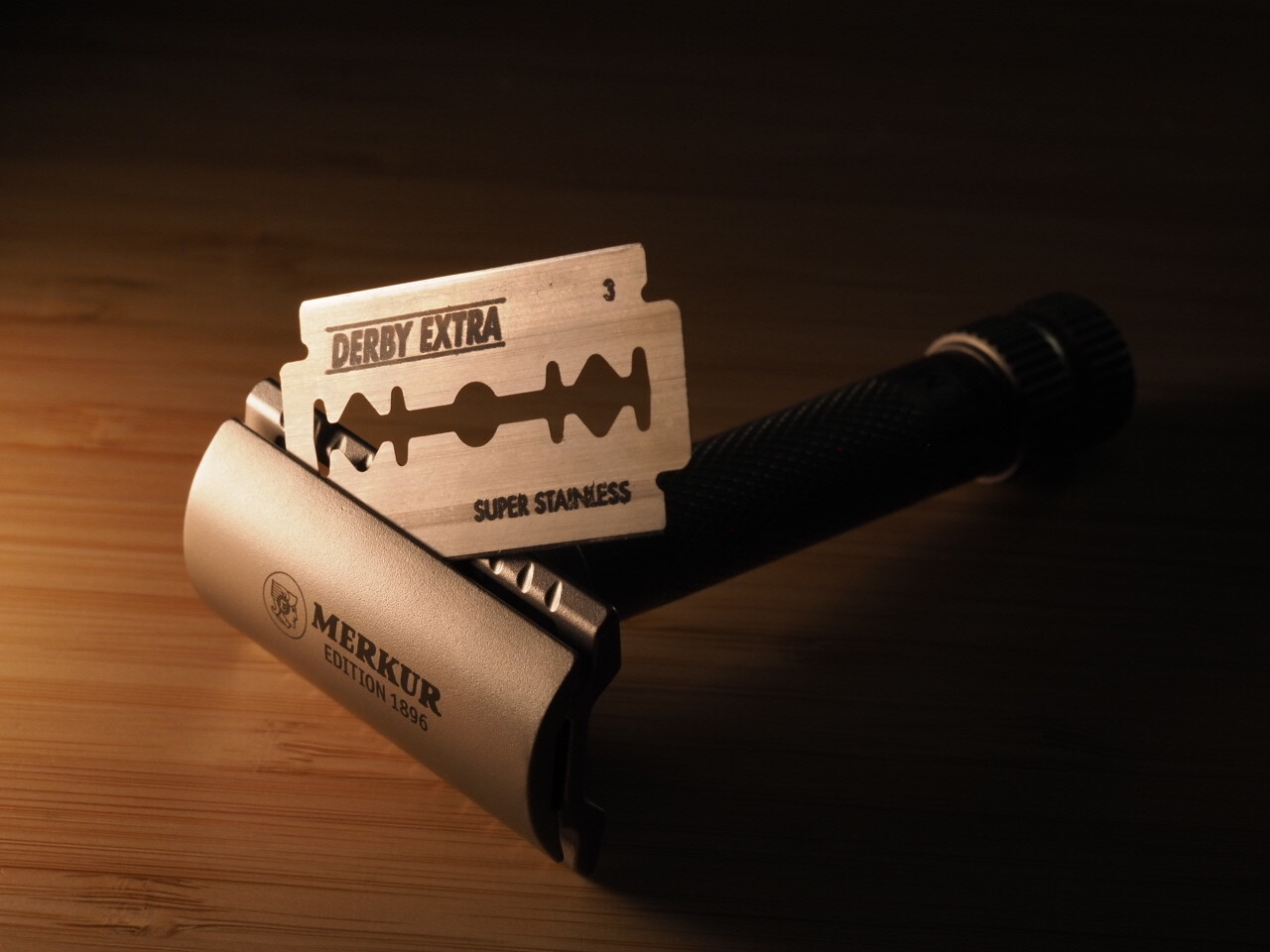
This is also noticeable in the blade you use. Since it's a razor with a rather gentle and forgiving geometry, a sharper or less sharp blade will have a significantly different impact. You can modulate the shave to some extent, as long as you keep in mind that going over the same area repeatedly with a loaded Feather razor, simply because the razor is gentle, can still cause irritation.

We've discussed this many times before: the gentlest razors don't always provide the "best" shave. Sometimes they leave stubble behind, or we don't manage to cut it properly in hard-to-reach areas. Then we get caught in a cycle of going over the same spot repeatedly and what we end up doing is irritating all that skin around those few hairs. This razor can become one of those razors if we're driven by the pursuit of a "perfect" shave with a less perfect razor.
Score: 14 points
Efficiency: 4
Head control: 3
Blade influence: 3
Indulgency: 4
Quality/Price

I think the razor is beautiful, more beautiful than its original counterpart. The matte gray of the material suits it very well and the engravings also make it more distinctive. Everything is a bit more defined, a bit more polished, a bit more sophisticated and I think it all looks great. It still has that industrial look that characterizes the original 34C but with more elegance.

But in terms of value, I can't give it more points than the original. We're talking about a razor that costs almost 160 Euros, which, although it deserves more total points than its sibling, doesn't radically change its core design. It remains very recognizable in everything that makes the 34C the 34C. And to charge over 100 Euros more just for changing the material... I don't even want to think about how much they'd charge for a titanium one.

Even so, it's an iconic razor in the world of shaving and I do believe there's a market for those who might want one in their collection. I imagine that in a quarter of a century, the prices of this special edition will remain relatively stable.
This razor has clear advantages over its original version and not just in terms of materials. The manufacturing process also improves the final result that Merkur offers. However, the same "disadvantages" of the original have been copied in this special edition. The short handle, the smooth geometry and the difficulty in changing the blade can be distracting. I love its history and everything it represents within the world of Solingen and shaving but it wouldn't be my favorite razor.
Score: 12 points
Aesthetics: 4
Reward: 2
Value in 25: 3
Single razor: 3
Conclusion
Solingen is the heart of European cutlery. No other city—not Thiers, Sheffield, Mataró, or Albacete—can truly rival it. Its reputation is well-deserved. Solingen has been producing quality for a millennium and it shows. This is also evident in Merkur's products. And considering the time period in which they were launched, these products met all the requirements perfectly.

That doesn't mean the razor is perfect. Times change and materials, production methods and the variety of razor head shapes have significantly altered the landscape. While the Merkur 34C was cutting-edge when it was released, today it's more of a low mid-range option. It still offers a perfectly adequate shave but it's quite different from what's currently available.
For me, these razors with a history will always hold a special place in my heart. I keep my 34C in my display case so I can look at it every day. I don't use it anymore but it deserves my respect for the city it represents and for its noble character. This special stainless steel version is better than its Zamak counterpart but both remain niche razors for a select few users. I hope other razors today can accumulate as much history as this one. Creating history isn't easy; the 34C did it and the stainless steel 34C continues that legacy. They’ve made it this far and history is hard to argue with. They must have earned it.
Final score: 69 points
Introduction
The Merkur brand is a classic in Solingen, a city in North Rhine-Westphalia located between Leverkusen and Wuppertal. This city has a protected designation of origin since 1938 and a long tradition of cutting tools. Naturally, razors and safety razors are also part of their offerings. The company was founded in 1896 by Emil Hermes, who couldn't use his surname because it was already registered. Instead, he used the Roman version of the Greek god Hermes, Mercury (Merkur). I've already told you this story in other reviews of Merkur razors but it's still worth repeating because it's the company's origin.
And after more than 125 years in the shaving market, Merkur is releasing several stainless steel versions of iconic razors from its catalog. The most iconic of these razors is the Merkur 34C, which this time is called the Edition 1896. This is the razor we'll be reviewing.
We all know the zinc alloy version, a version with a utilitarian design that's comfortable to use, safe and forgiving. One might assume that the same razor made of stainless steel would be identical to its older sibling but that would be a mistake. There are quite a few differences between the two razors, which we'll go over in this review... and not all of them are for the better...
Construction
The Merkur 34C Edition 1896 is a two-piece (or three-piece, depending on how you interpret it) DE razor manufactured using MIM. It uses two different steels. The handle is made of AISI 303 and the head (base plate and cap) is made of AISI 316L. AISI 303 is a softer and less corrosion-resistant material than 316L but even so, this razor will outlast us all with only minimal care.
Solingen's shaving industry wasn't (and still isn't) focused on razors but on straight razors. These fine tools were (and still are) the core of the city's manufacturing, with their own protected designation of origin. Therefor, a straight razor must be manufactured, polished and sharpened within the Solingen region to bear the city's name. This quality control is part of the process to maintain Solingen's prestigious reputation.
Solingen received its city charter in 1374 from the Counts of Berg, although the region already had metallurgical activity in medieval times. The will of the Archbishop of Cologne mentions a place called "Solagon" in 965 and in 1067 a chronicler refers to the place as "Solonchon," creating a documented link in the long history of this region.
As is typical, the inhabitants took advantage of what nature offered in their environment to thrive and this region is characterized by mineral deposits, lush forests and fast-flowing rivers that allowed the use of watermills to mechanize the forging, sharpening and tempering of cutting tools. These workshops, located beside the tributaries of the Wupper River, were called "Kotten" and were the catalysts that propelled this region to the forefront of European cutlery.
The city became the cradle of cutlery and knives and today it still produces 90% of all knives in all of Germany. Some well-known brands established in this city are Henckels, Boker, Wüsthof, Puma, Dovo and Merkur and the Solingen label remains a mark of high quality recognized worldwide. This makes Merkur a brand that has to maintain a top-notch reputation and for a long time they did just that with their safety razors, using modest but highly functional designs and humble materials with a reasonable finish to keep prices affordable. This strategy worked very well and Merkur has a wide variety of models that remain benchmarks in the world of shaving despite their age.
Models based on older designs, such as the 15, 23, 34 and 41, are the most utilitarian and offer cuts that have earned a place in the long history of shaving. But that's not all. The 500 series, the adjustable Progress, is also a shaving icon that Merkur has tried to surpass with its 700 series, the Futur, which looks like a device from a much more advanced era.
The most advanced for its time was the Merkur Vision 2000, an adjustable butterfly razor made of aluminum, brass and stainless steel. Too "modern" and expensive for its time, it didn't have a long lifespan and is now considered one of Merkur's unicorn razors.
During the early 2010s, classic shaving experienced a resurgence and many manufacturers entered the market. Merkur already had models that had been top sellers for decades and continued with its traditional designs and manufacturing processes, using zinc alloy and chrome plating for its products. But while the competition improved materials, tolerances and production methods, Merkur stuck with its traditional products.
This changed because they recently introduced an alternative line in their catalog where they use stainless steel to recreate some of their most iconic models, such as the 23 and 34. Using the MIM (Metal Injection Molding) technique, they manufacture these models in different types of steel. MIM is a technique that combines plastic injection molding with a mixture of steel powder to create parts in molds with greater precision than with cast material (such as zinc alloy) but with less precision (and lower cost) than CNC machining. Other famous razors manufactured using MIM are the Rockwell 6S and the Mühle Rocca, two razors that have performed quite well.
Material: 316L stainless steel (lid and base plate), 303 (handle)
Finish: Matte Gray
Handle length: 76 mm
Handle diameter: 11.6 mm (Knob: 14 mm)
Total length of the razor: 83 mm
Total weight: 77 gr
Cap weight: 15.6 gr
Cap height: 4.7 mm
Lid width: 19.39 mm
Gap: 0,71 mm
Exposure: neutral
Focusing on the 34C stainless steel model we have here today, we can see a very recognizable top section of the cap, as it has the same curve as its chrome counterpart. In the center of the cap, we see the logo and brand name, along with "Edition 1896," giving this special edition its distinctive touch. A nice detail.
In profile, we see the silhouette of almost all the caps that follow this design. A fairly pronounced curve, a somewhat thick cap and two mounting surfaces that create a relatively gentle cutting angle. Many Type 34 and R89 razors use this cap profile and provide smooth shaves with a moderate amount of efficiency.
Inside the cap, we see two major differences compared to the Zamak version. The central thread on the steel version is much shorter and it uses longitudinal guides instead of cylindrical ones. These guides provide a more precise positioning of the blade.
Inside the cap, we also see two elements that clearly indicate this part was created using MIM (Metal Injection Molding). First, we see the injection channels in the center of the cap. The combined paste of steel powder and carrier agents, which are largely removed during the process, is introduced through these channels.
We also see that the thread has two flat parts, one on each side. This also indicates that MIM was used. The paste is injected into a mold made of two parts that fit together. Once the piece is molded, the parts separate and the piece is removed. There are always marks visible at the seam where the two mold parts meet because there's always some space where the paste can be inserted. This is often seen in plastic parts and these burrs are easily removed. However, a thread has cavities and at the seam, the material would be forced into the threads, creating an obstruction within them. Therefore, flat surfaces are used where the mold pieces join, so that any potential marks don't interfere with the threading process and can be easily polished.
Looking at the profile of the base plate, we can clearly see the line which forms where the two parts of the mold meet. In this case, the mold has a top and bottom section that follows the side line of the plate. On this surface, the seam line does not interfere with the proper functioning of the razor and can be easily polished.
And the base plate reveals another significant difference compared to its Zamak counterpart. Not only does the cap screw on but the base plate itself also screws on. In the original, the handle is press-fitted into the base plate. When manufacturing the base plate for this stainless steel version, the central hole is likely unthreaded. It's produced with smooth walls. After the plate is fabricated, a central thread is cut into it to allow mounting on the handle, which is lathe-machined from a softer steel than the cap and plate.
On the inside of the base plate, we see the central body with the central thread for the handle and the openings for the longitudinal guides. These openings are considerably larger than the guides on the cap. We can see some manufacturing marks where the paste didn't fill all the gaps or where the transfer agents were removed. Two mounting rails complete the central body.
Along the long sides of the central body, we see the combs, which have four supports that create three rinsing channels. The original razor only has two supports, creating one wide, continuous channel.
On the underside of the plate, we see everything we also saw inside. The holes clearly show that the tolerances are quite generous when everything is assembled. We also see the circular mold entry and exit points. By placing these entry points on the underside of the plate, they are largely hidden from view. A good choice. They could have been hidden even more if the entry and exit points had been placed on the inside of the base plate but that could have affected the tolerances of the mounting rails. Being the highest part of the plate, some of the entry and exit points should have been positioned directly on the rails, thus leaving those circular marks right where the blade is clamped. They chose not to take that risk and I think they made the right decision. The finish and tolerances are better than the Zamak version but not by much. MIM machining has its limitations and isn't as precise as CNC machining. Even so, all the shapes of the Zamak version are more defined in the steel version. It undoubtedly looks the part.
The finish is that typical gray that looks like it's been bead blasted but it's simply the steel left like that after the solvents that turn steel powder into a moldable paste, are removed. It's a very good finish that's functional and clean. It can be polished but these gray, slightly rough finishes always look good, not only aesthetically but also functionally.
The razor's name is printed on the cap and at the base of the handle, just above the knob used to (un)screw the cap. The handle displays the logo and brand name, the material and the protected designation of origin from Solingen, Germany. These details are very attractive and make it stand out.
The set also comes with a leather case, engraved with the name and special edition. Another nice and practical detail that allows you to take the razor with you when traveling without fear of damaging it.
The comb is slightly different from the original version. The front surface, where the grooves are located and which forms part of the shaving surface, is more defined than in the original version. It's somewhat wider, has more defined grooves and is slightly thicker overall without changing the gap. It's a very comfortable and functional head. Being German, we could call it the Volkswagen Golf of shaving. Very recognizable and super easy to use.
Score: 16 points
Material/Construction: 4
Finish: 4
Tolerances: 4
Head/comb shape: 4
Grip
The grip is also a slight improvement over its predecessor. The material offers greater friction than the chrome plating of the original. And because it lacks a chrome coating, the central knurling and the fillets on the knob are (much) more defined. In short, it improves upon all the elements of the original except for the length. The handle remains one of the shortest on the market and only allows for a two-finger grip.
The material has a pleasant feel and is comfortable. The only part that's slightly more noticeable is the top of the knob's grooves. They offer more grip due to their greater definition but they also have sharper corners. This reduces comfort somewhat. Every advantage has its disadvantage.
The control isn't bad because the knob helps a lot in finding grips that work but the razor is short and that always needs to be taken into account. You can distance your fingers further from the head for better visibility and reducing the times your fingers are covered in shaving residue but everything revolves around the knob. The razor isn't very light for its compact shape either, which forces you to find grips that don't compromise its use. When there’s more weight to move around but less grip, you need to make due with what you have available.
The glide is good. The shaving surface is very easy to find and the weight helps the razor glide smoothly. The surface is somewhat rough and with soaps that have slightly less lubrication, you can feel it stretching the skin more as it passes over it. It's not bothersome because stretching the skin also helps with the cut, especially with less efficient razors like this one but you do notice a bit more friction. The grooves allow some lubrication to pass through but they aren't very deep.
Score: 15 points
Dry/Wet: 4
Comfort: 4
Control: 3
Head slide: 4
Handling
Being such a short razor, with a hollow handle due to the threading that has to reach from the knob to that very short thread on the cap (yes, we'll talk more about that devilish threading later…) and a head that doesn't skimp on materials, the balance point is located in a perfectly logical spot but very close to the head. As I said before, this shouldn't be a problem if you like the smell of shaving cream in the morning on your fingers or if you're happy with an alternative grip. The weight is also no surprise. It's nearly 80 grams of steel in a tiny body. It feels solid and compact, conveying an industrial feel, just like its sister razor. This razor feels more like an industrial tool than a surgical instrument. Both have their place in this world and the Merkur Edition 1896 never hides what it wants to be.
What did disappoint me quite a bit was the short thread on the cap. One of the great advantages of two-piece razors is how safe they are when you assemble them. You place the blade in the cap, put the cap and blade assembly onto the base plate and move your fingers away from the blade to tighten the thread with the knob. Super safe and convenient.
If you use the same procedure with this Merkur 34 1896, you'll be in for an unpleasant surprise. The guides aren't high enough to reach the base plate and the internal thread is either too long or the cap's thread is too short. This means that when you place the cap with the blade on top of the base plate, everything is precariously balanced on the central thread.
And if you start turning the knob to tighten the screw, the whole cap with the blade starts turning too! There's no other option but to grip the sides of the cap and the blade with your fingers and tighten the screw with the knob, which, with this design, is anything but a comfortable operation. I'd say it's considerably more awkward than assembling a conventional three-piece razor. It turns its greatest advantage in its greatest disadvantage.
The reason is the large gap between the cap and the plate when you assemble everything, forcing you to support the entire weight of the razor with two fingers on the short sides of the head while turning the screw with the knob. For me, it's clearly a missed opportunity. The central thread should have been slightly longer so that the internal thread could have been shorter, allowing the cap to be positioned closer to the plate so the guides would align with their holes. This would have prevented the cap from shifting while screwing it on.
Cleaning is also somewhat hampered by the handle's design. The cap presents some obstacles, as does the comb but it's the inside of the handle where limescale and residue tend to accumulate. It's likely possible to disassemble it but it doesn't seem very easy to do. The comb also presents more obstacles than the original version due to its additional supports. The surface, however, is easy to clean as it doesn't attract fingerprints.
Score: 12
Balance: 3
Weight: 3
Model: 3
Cleaning: 3
Shaving
The original Merkur 34C shaves well but it's not a super-efficient razor. It's a razor that performs very well once you get the hang of it. And with this Edition 1896, the story is the same. The geometry is the same but I prefer the shave this steel version offers to the original Zamak one.
And I think the reason lies in the slightly improved design of the comb, which creates a super comfortable and very easy-to-maintain shaving plane. More than anything, this razor offers a very comfortable and relaxed shave. It's not the closest shaver; in that respect, it's similar to its better-known rival, the R89 but that's not necessarily a bad thing.
The head isn't too bulky but it's not the smallest either. You can easily reach all areas. The problem arises when you have to change your grip and "force" the cut a bit because of its inherent softness. To shave well in areas where the hairs are somewhat hidden, you have to press harder and that can cause other problems. The same is true if the handle isn't long enough to properly position the head and/or apply that pressure. A shorter handle means less leverage.
This is also noticeable in the blade you use. Since it's a razor with a rather gentle and forgiving geometry, a sharper or less sharp blade will have a significantly different impact. You can modulate the shave to some extent, as long as you keep in mind that going over the same area repeatedly with a loaded Feather razor, simply because the razor is gentle, can still cause irritation.
We've discussed this many times before: the gentlest razors don't always provide the "best" shave. Sometimes they leave stubble behind, or we don't manage to cut it properly in hard-to-reach areas. Then we get caught in a cycle of going over the same spot repeatedly and what we end up doing is irritating all that skin around those few hairs. This razor can become one of those razors if we're driven by the pursuit of a "perfect" shave with a less perfect razor.
Score: 14 points
Efficiency: 4
Head control: 3
Blade influence: 3
Indulgency: 4
Quality/Price
I think the razor is beautiful, more beautiful than its original counterpart. The matte gray of the material suits it very well and the engravings also make it more distinctive. Everything is a bit more defined, a bit more polished, a bit more sophisticated and I think it all looks great. It still has that industrial look that characterizes the original 34C but with more elegance.
But in terms of value, I can't give it more points than the original. We're talking about a razor that costs almost 160 Euros, which, although it deserves more total points than its sibling, doesn't radically change its core design. It remains very recognizable in everything that makes the 34C the 34C. And to charge over 100 Euros more just for changing the material... I don't even want to think about how much they'd charge for a titanium one.
Even so, it's an iconic razor in the world of shaving and I do believe there's a market for those who might want one in their collection. I imagine that in a quarter of a century, the prices of this special edition will remain relatively stable.
This razor has clear advantages over its original version and not just in terms of materials. The manufacturing process also improves the final result that Merkur offers. However, the same "disadvantages" of the original have been copied in this special edition. The short handle, the smooth geometry and the difficulty in changing the blade can be distracting. I love its history and everything it represents within the world of Solingen and shaving but it wouldn't be my favorite razor.
Score: 12 points
Aesthetics: 4
Reward: 2
Value in 25: 3
Single razor: 3
Conclusion
Solingen is the heart of European cutlery. No other city—not Thiers, Sheffield, Mataró, or Albacete—can truly rival it. Its reputation is well-deserved. Solingen has been producing quality for a millennium and it shows. This is also evident in Merkur's products. And considering the time period in which they were launched, these products met all the requirements perfectly.
That doesn't mean the razor is perfect. Times change and materials, production methods and the variety of razor head shapes have significantly altered the landscape. While the Merkur 34C was cutting-edge when it was released, today it's more of a low mid-range option. It still offers a perfectly adequate shave but it's quite different from what's currently available.
For me, these razors with a history will always hold a special place in my heart. I keep my 34C in my display case so I can look at it every day. I don't use it anymore but it deserves my respect for the city it represents and for its noble character. This special stainless steel version is better than its Zamak counterpart but both remain niche razors for a select few users. I hope other razors today can accumulate as much history as this one. Creating history isn't easy; the 34C did it and the stainless steel 34C continues that legacy. They’ve made it this far and history is hard to argue with. They must have earned it.
Final score: 69 points


 ) but after the first use.